

IN A COASTAL TOWN IN SOUTHWESTERN ENGLAND, CURATOR VIVIENNE ROBERTS PRESENTS AN EXHIBITION SHOWCASING ART THAT STRIKES A PSYCHIC CHORD
Published on March 19, 2026
“Tranceducers: Art of Visionaries, Mediums and Automatists”
The Crypt Gallery
Norway Square, St. Ives, Cornwall TR26 1NA England
March 13 – 20, 2026
by Edward M. Gómez, with reporting by Cathy Ward
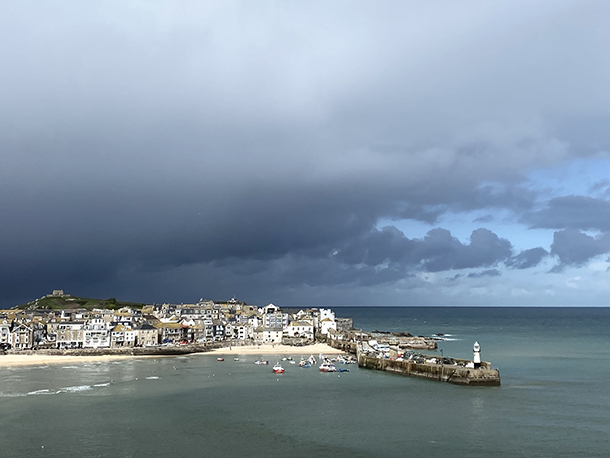
The Crypt Gallery in the small, coastal town of St. Ives, in Cornwall, in the southwesternmost corner of England, is the setting for the second and most recent presentation of “Tranceducers: Art of Visionaries, Mediums and Automatists” a 23-artist group exhibition organized by the independent curator Vivienne Roberts, which was first shown in London last year.
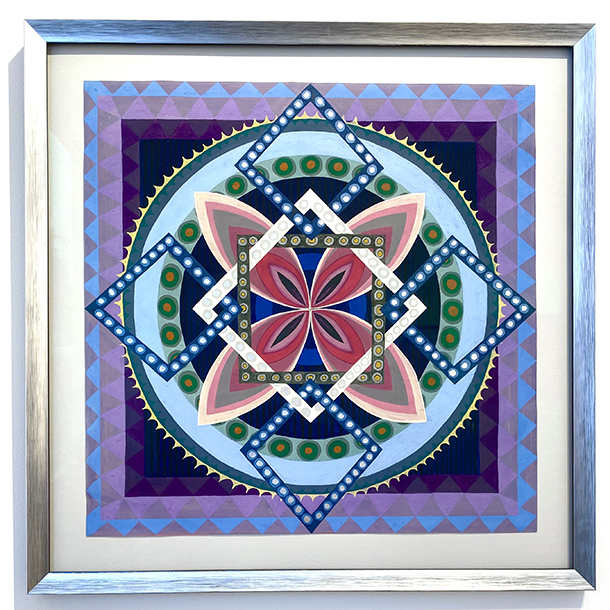
As Roberts describes it, “Tranceducers,” a thematic, group show, offers “an exploration of artistic practices shaped by alternative perceptions, otherworldly transmissions and intuitive mark-making” in a variety of artworks produced by “both historical pioneers and contemporary practitioners from around the world.”
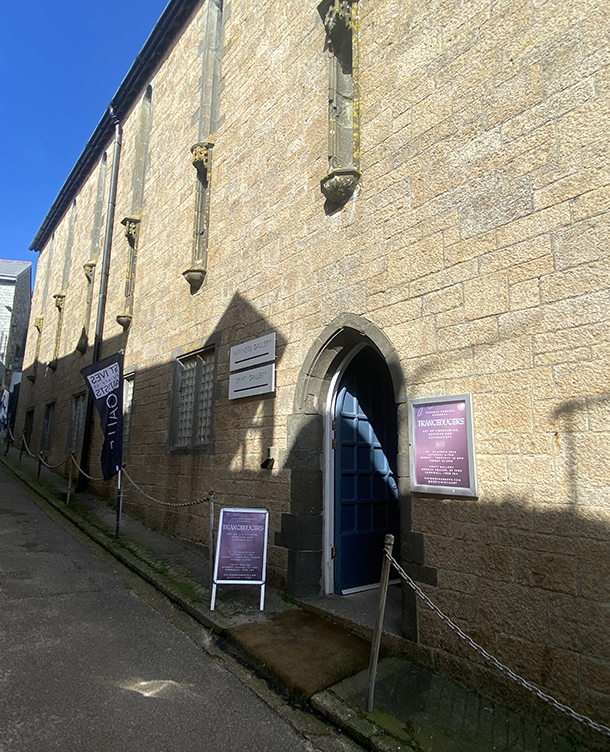
The exhibition includes works made by mediumistic creators who believed that their art-making activity was propelled or stimulated by external forces, conveying some kind of hidden knowledge or what Roberts has referred to as “messages from other worlds.”
Also on view are works made in an automatist manner, spontaneously and without preliminary planning or deliberation, in which artists abandoned conscious control of their art-making gestures or methods. “Tranceducers” also features works made by so-called visionary artists, whom Roberts has described as those who “offer radically different ways of seeing the universe, revealing dimensions we may have sensed but never fully perceived.”
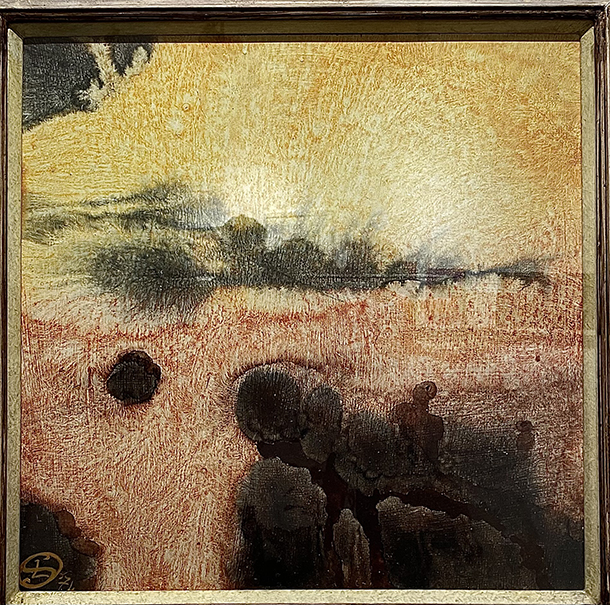
On view are works by such familiar creators as the British artist Madge Gill (1882-1961), who has long held an iconic place in the annals of art brut, and Nnena Kalu, a contemporary, London-based, self-taught artist who won the 2025 Turner Prize. Kalu is known for her large, colorful, mixed-media sculptural works made with bound and bundled scraps of fabric, tape, paper, and strips of soft, pliable plastic. In “Tranceducers,” one of Kalu’s abstract drawings on paper is on display. Her drawings voluminous, wiry, coiling forms vividly relate to those of her monumental-feeling sculptures.
With this exhibition, Roberts has also introduced or shed light on the generally less well-known works of such artists as Aleksandra Ionowa (1899-1980) and Ernest J. Gerrard (1875-1963), or those of the British occultist Ithell Colquhoun (1906-1988), who met André Breton in Paris in 1930 and adopted the automatist approach to art-making that greatly interested the Surrealists, employing it in her own writing and art-making.
A former curator and archivist at the College of Psychic Studies in London, Roberts has long focused her research on the lives, ideas, and art-making accomplishments of mediumistic and spiritualist artists, and those who were deeply interested in or influenced by the occult and various aspects of what is known as esoterica.
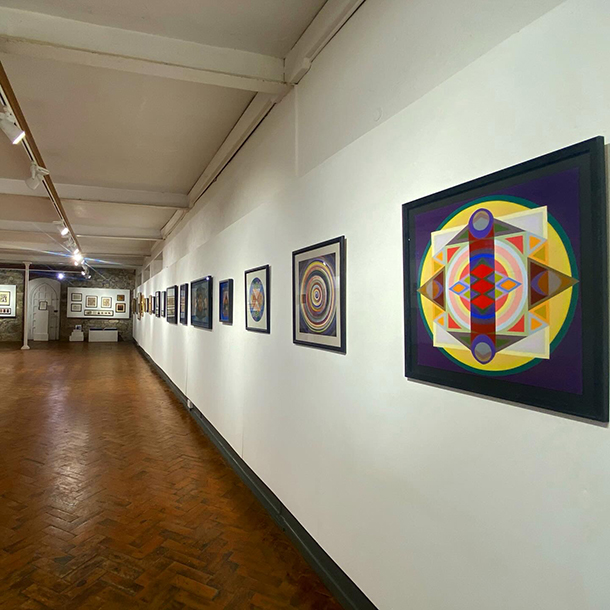
In assembling the “Tranceducers” exhibition, Roberts was especially inspired by the work and thinking of the British artist Victor Bramley (1933-2014), who, as she notes in the show’s accompanying, introductory text, “was born in Yorkshire and moved to St. Ives in 1959 to pursue his love of adventure and art.” Roberts recalls, “In 1967, he took up yoga and meditation, which coincided with a radical change in his art. He began to experiment with automatic techniques and immersed himself in divinatory studies, such as astrological charts, runes, and [the] I Ching [a divination manual produced during ancient China’s Western Zhou era (1000–750 BCE).]” It was Bramley who coined the term “tranceducers.”
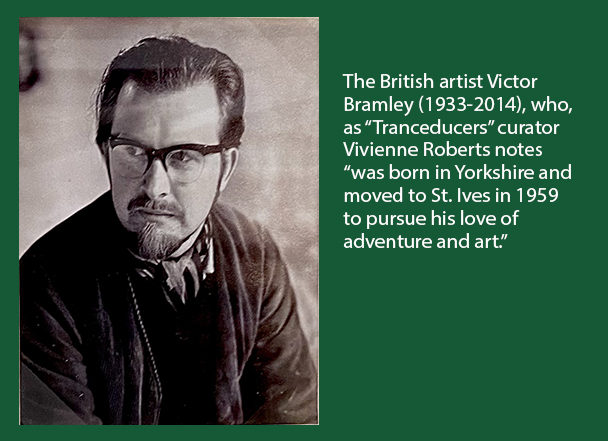
Victor Bramley’s work dominates the exhibition, with a large selection of his work on display.
About Ithell Colquhoun, Roberts’ explanatory text notes that, as a member of the Surrealists’ circle, this female, British artist “witnessed firsthand the automatic techniques used by [the] artists Roberto Matta and Gordon Onslow Ford, […] inspiring her to develop a personal, psycho-morphological practice resulting in her theory of the ‘mantic stain.’ Her techniques included decalcomania, frottage, collage, fumage, parsemage and other chance-based procedures [that] allowed her to bypass conscious control and access deeper psychic revelations.”
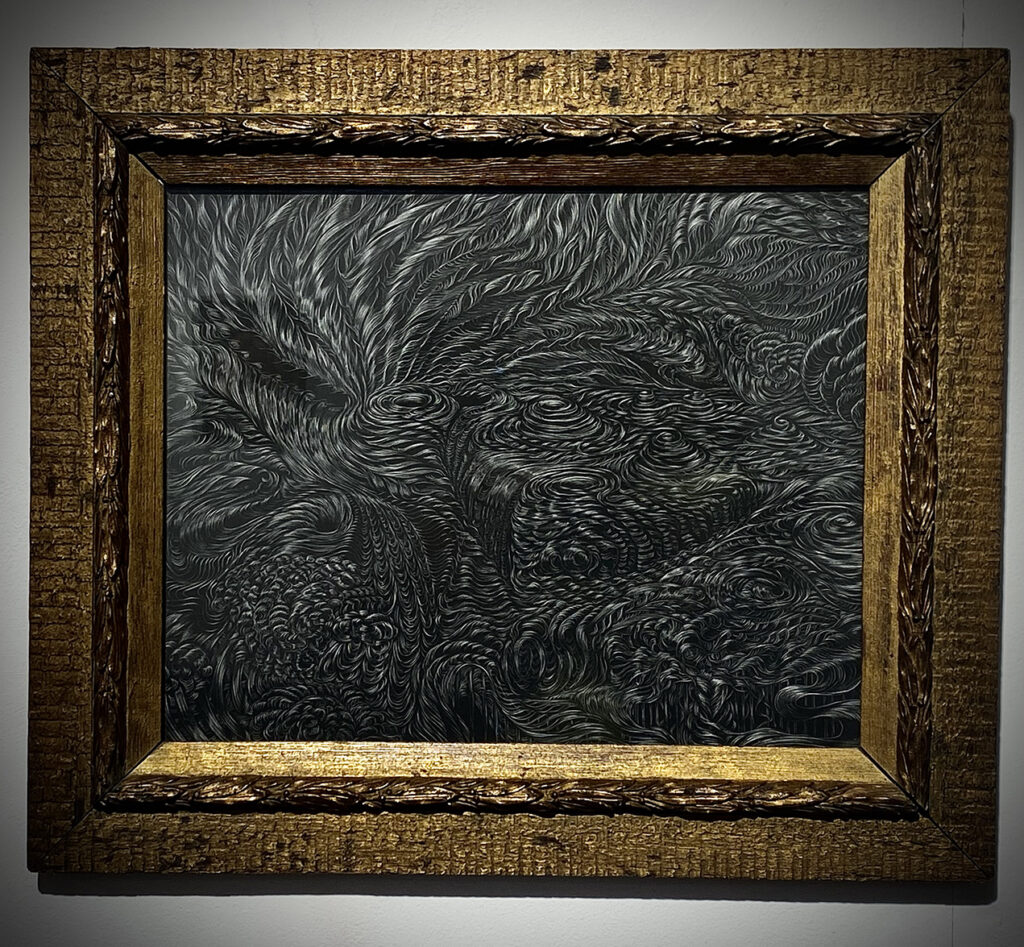
Colquhoun wrote essays titled “The Mantic Stain” (1949) and “The Children of the Mantic Stain” (1951), in which she elaborated her ideas. In them, Roberts points out, the artist proposed that “creating a spontaneous mark could lead to a deeper consciousness, which could be developed pictorially with conscious control. Roberts observes, “For Colquhoun, these stains were not just aesthetic devices but tools of gnosis, aligning with esoteric principles of scrying, and inner vision.”
[Editor’s note: Scrying refers to an ancient divination practice involving gazing into reflective surfaces — crystal balls, water, black mirrors — to induce trance-like states and acquire psychic insights, provoke visions, or reveal hidden knowledge.]
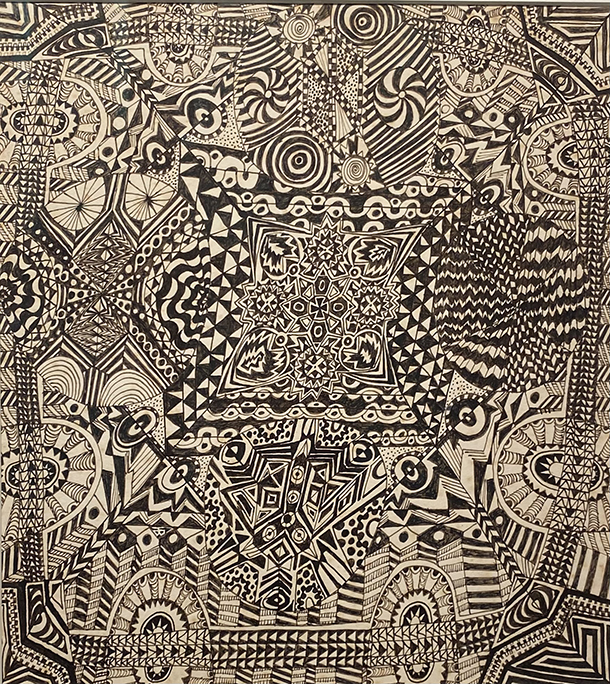
Viewers who are familiar with Madge Gill’s abstract and semi-abstract drawings, many of whose compositions are dotted with female faces bobbing in an out of thickets of cross-hatched lines, are probably aware that this self-taught artist created her unusual images while experiencing trance-like states.
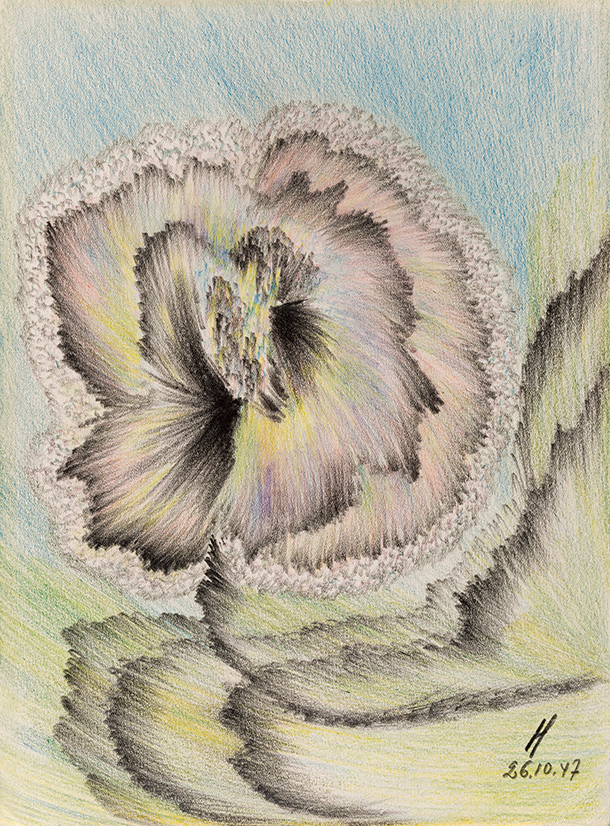
Mediumistic art, Roberts explains, tends to feature or allude to “strange esoteric symbols, ancient languages, primordial creatures, fairies and nature spirits, extraterrestrial figures, planetary landscapes, abstract auras, emanating energies, as well as gloriously numinous flora.”
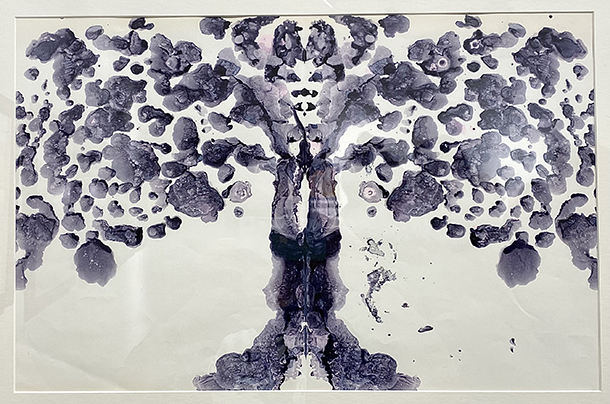
With such characteristics in mind, “Tranceducers” features representative works by Aleksandra Ionowa. Roberts describes this Finnish artist as “a proponent of Theosophy, a movement equal in popularity to Spiritualism that encouraged spiritual exploration and celebrated art that revealed visual forms perceptible to those with clairvoyant abilities.”
Artists whose works appear in the St. Ives presentation of “Tranceducers” include:
Melissa Alley, Victor Bramley, Etty Buzyn, Ithell Colquhoun, Madge Donohoe, Ernest J. Gerrard, Madge Gill, Amy Grantham, Greg Humphries, Aleksandra Ionowa, Louise Janin, Nnena Kalu, Josef Kotzian, Cara Macwilliam, Cecilie Marková, Marianne McCarthy, Allen o2o Moore, Jacque Moran, Chris Neate, Grace Pailthorpe, Kate Southworth, Cathy Ward, and Sue Williams A’Court.