

brutjournal CONTRIBUTING PHOTOGRAPHER AND PAINTER STEVEN HIRSCH STUMBLES UPON A DECEASED, SELF-TAUGHT ART-MAKER’S TREASURES
Published on February 10, 2026
by Edward M. Gómez, with Steven Hirsch
NEW YORK — The annals of art brut and outsider art are filled with stories of the discoveries of unusual bodies of work — paintings, drawings, sculptures, carvings, and, often, other hard-to-label, peculiar creations — made by deceased self-taught artists about whose lives little was known at the time they were found.
Likewise, even many years after such big finds, many key questions about the trajectories of such art-makers’ lives as well as about their motivations for producing their strange creations may linger until researchers, if they’re lucky, happen to encounter sources that can provide solid answers to their queries.
Since its launch in 2021, brutjournal has introduced the works of numerous, hitherto unknown self-taught art-makers whose works can properly be placed in the art brut or outsider art categories, including, for example, an anonymous Swiss maker of drawings and mixed-media garments known as “E.B.,” who was born in 1948 and died in 2011, and Shirley Cohen (1922-2019), a creator of futuristic paintings and site-specific murals who worked at her home in the New York City borough of Queens.
More recently, the New York-based photographer and artist Steven Hirsch (Instagram: @stevenhirsch), a regular contributor to the magazine, made a remarkable discovery at a flea market in Manhattan.
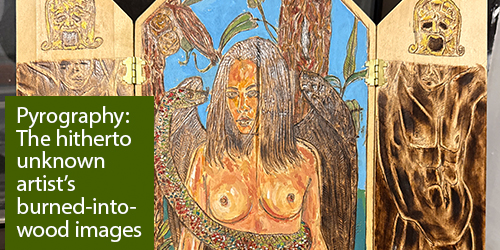
Since stumbling upon a group of unusual pictures made by burning image-forming lines into the surfaces of wooden boards, like a sleuth determined to dig up the facts of an intriguing mystery, Hirsch has made a dogged effort to learn the identity of the maker of the artworks he found and acquired; now, following a few months of research, he shares the story of his big discovery with brutjournal.
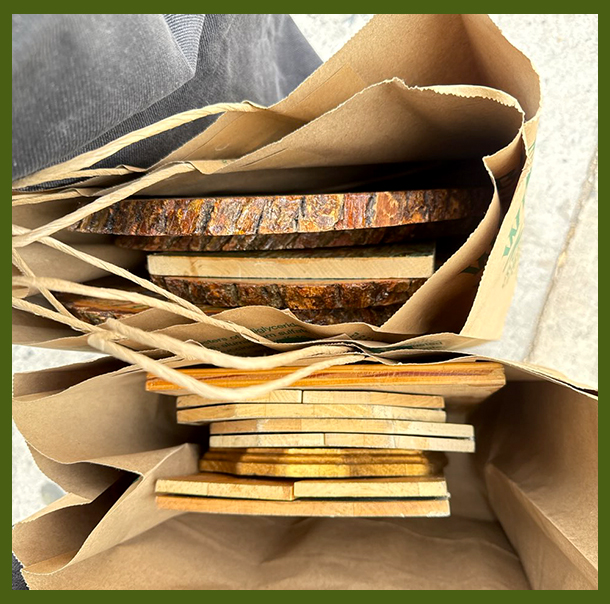
“I like visiting flea markets,” Steven told us. “One weekend last November, I was looking through the stuff on sale from different vendors at a flea market I like to check out regularly, and that’s where I found a paper bag full of these pictures on boards. They were all quite wonderful. They had been sketched by burning into the wood, and then the burned-in images had been painted over with oil.”
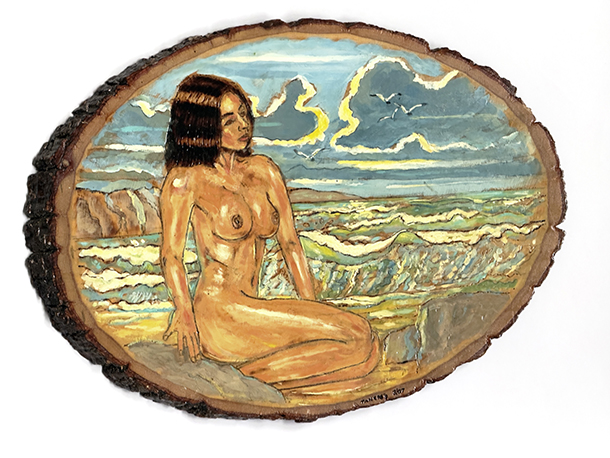
Hirsch added, “They looked like the works of a self-taught artist who was striving to make realistic images of women. They tended to depict nudes, and there was a hint of the erotic about them; whoever made these pictures had attempted to create images that looked and felt artistic and a bit erotic at the same time. I bought all 12 of the pictures that were being offered for sale.”
Hirsch learned that the vendor who was selling the unusual artworks had obtained them from janitors who had found the pictures while they were cleaning out Calhoun’s apartment after his death. The maker of the art pieces had resided there during the latter years of his life. Steven also learned that the technique the artist had used to make his pictures has a name — pyrography, a word of Greek origins meaning “writing with fire.”
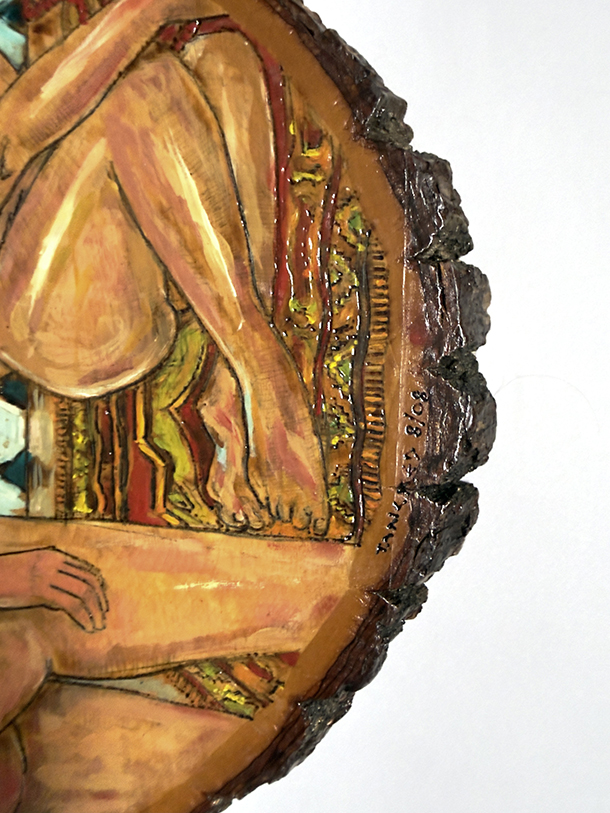
The pyrographic method of decorating wood with burn marks or, with more precision and a sense of draftsmanship, of burning images into a wood surface results in a sketched look characterized by a natural kind of shading.
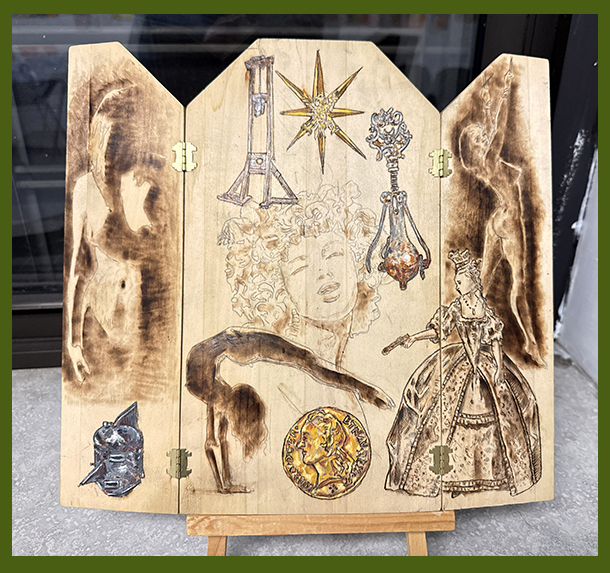
Buoyed by the initial, small nuggets of information he was able to gather, Hirsch found out that the maker of the burned-wood images was a U.S. Army veteran named Tancred Calhoun, who was born in 1947 and died in 2020 at the age of 72. For many years, he had resided in Tanya Towers, an apartment building in downtown Manhattan’s East Village area. Among the units in that building, there are apartments for disabled persons, senior citizens, and military veterans.
At one point during his search for the artworks’ maker, Steven sent me a text message saying, “This morning, I called the Veterans Administration hospital where Calhoun routinely went to see a psychotherapist. It’s part of a VA medical center located on East 23rd Street in Manhattan. After obtaining the therapist’s name from a hospital employee, I was able to find his home address on Manhattan’s Upper West Side, where, apparently, he lives today. I’m going to try to track him down and ask him if he might be willing to share his memories of Tancred Calhoun with me.”
Later, Steven reported, “Unfortunately, my trip to the Upper West Side turned out to be fruitless. The therapist no longer lived at the address I had found but he was active on Facebook, where I reached out to him. He soon responded.”
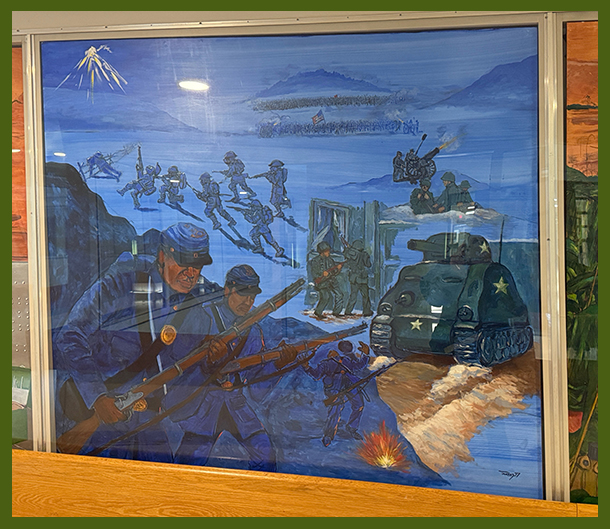
Steven visited the VA hospital with which Calhoun had been associated. There, he was surprised — and delighted — to find a group of murals Calhoun had painted. When and why he undertook such an assignment — the details of this project remain unknown.
About the murals, Steven noted, “They’re pretty great. Unfortunately, though, with the electric light and reflections inside the hospital building, it’s impossible to photograph them properly. They’re mounted on the walls in a hallway, where they’re covered with protective, clear-plastic sheets. When I visited the hospital, I saw a lot of men my age in dressed in camo.”
Calhoun’s murals appear to depict American troops in various historical battle scenes, from Union soldiers in the U.S. Civil War era to U.S. army infantrymen in what seem to be the farm fields of Southeast Asia. In these pictures, which appear to have been made with acrylic paint on board, Calhoun’s draftsmanship is amateurish but ambitious as it presents its subjects with a studious sense of attention to detail.
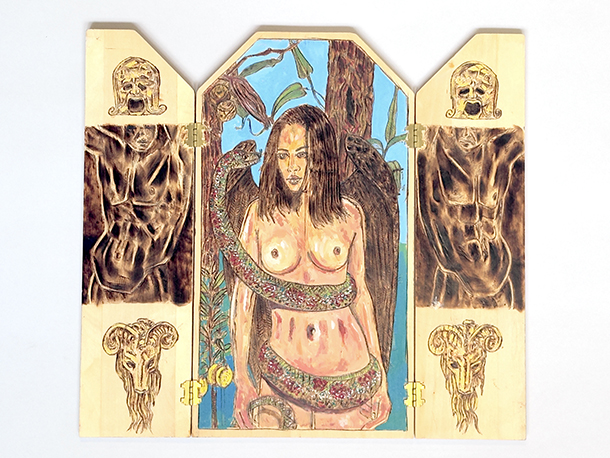
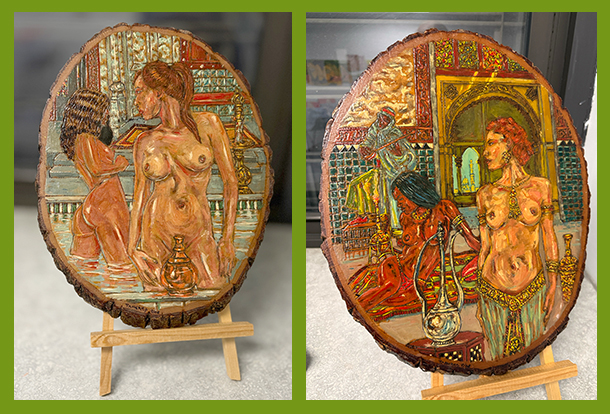
The artist’s pyrographic works feature female nudes or casually dressed young women wearing jeans and bikini tops or, in one picture, a snake. (In this image, a large serpent wraps around a nonplussed nymphet’s torso and strikes a pose; it looks straight into its buxom captive’s eyes.) In several of these pictures, whose eroticism feels a bit stilted, Calhoun’s models sit on a beach at the water’s edge, or gather in what seems to be some sort of louche, Asian salon or lounge room.
In one of them, a nude woman reclines on a group of rather uncomfortable-looking rocks in a pond while a large, shaggy animal (an aberrant anteater?) tickles her crotch with its long snout. One of Calhoun’s female subjects stands in front of a pagoda.
Steven did manage to find and speak by telephone with Steven Grossman, a now-retired, licensed social worker and psychotherapist, who for many years had treated Calhoun, both as an individual patient and as a participant in a support group for military veterans affected by post-traumatic stress disorder (PTSD). From Grossman, Steven learned that, following a tour of duty fighting in the Vietnam War in the early 1970s, Calhoun had returned to the United States suffering from PTSD and depression.
Recalling his interaction with Calhoun over a long period of time, Grossman told Steven, “I knew Tancred Calhoun for about 20 years. I knew him quite well as a patient and as a member of our Vietnam Vets group. He was a very bright man. Somewhat alienated but not isolated, since he came to the VA psychiatric day program on a regular basis. He did a lot of his artwork there and also some at home, but it wasn’t easy for him to be at home. He was fairly downtrodden. He didn’t have much money. He lived off a VA pension.”
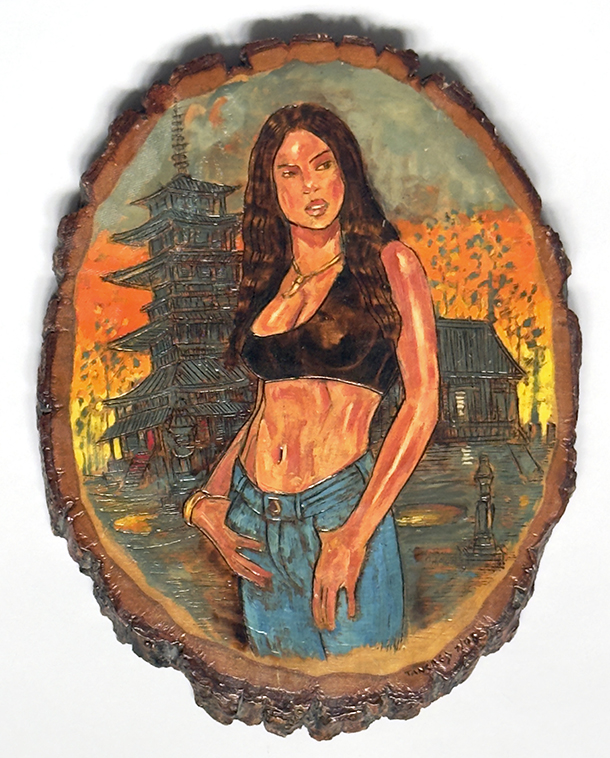
Grossman recalled that Calhoun worked on a variety of art projects, including his burned-wood pictures, and that he took part in an annual art exhibition sponsored by the VA hospital, which it presented in the hospital building’s lobby. The retired psychotherapist noted that, for Calhoun, his art-making was definitely a therapeutic activity that he pursued with enthusiasm.
Calhoun had a brother who lived with him for a while; according to Grossman, he, too, was not well integrated into society. The two brothers were close, with Calhoun’s brother becoming the artist’s caregiver during the latter years of his life, by which time he had to use a wheelchair to get around. Calhoun was tall and overweight. Grossman estimated that he weighed around 300 pounds.
Recognizing the sexual themes that simmer in Calhoun’s art, Grossman observed, “His work could have expressed his repressed sexuality; it could have given him some pleasure to get his fantasies down on canvas. He never really said anything about [the meaning of his art].”
Steven asked Grossman, “Given their sexual energy — their sense of lust and sensuality — did you ever find Calhoun’s art to be shocking?”
The psychotherapist replied, “You know, after 30 years of working with veterans with post-traumatic stress disorder, there wasn’t much that could shock me. What I can say is that I did get a good chuckle out of some of Calhoun’s works. I’m thinking, for example, of one that I saw one time featuring a woman and a cactus.”
Steven Hirsch has observed, “Tancred Calhoun used a hot pen and what others might have regarded as mere scraps of wood to express himself in a way that make sure that what he experienced in his inner life would survive in a tangible form. When I hold and examine his works today, I realize that they are not just works of art. For Calhoun, they were the windows he carved into the confining walls of his room so that, finally, he could breathe.”
[See our separate article featuring Steven Hirsch’s recounting of his discovery of Tancred Calhoun’s works and his search for information about the late artist’s life.]
Below: A photo by Steven Hirsch showing a detail of one of Tancred Calhoun’s works in which the artist used the pyrography technique to burn the lines of a drawing into the surface of a piece of wood. Then he painted over the lines he had made.