
COMING FROM A TECHNICAL BACKGROUND IN TELEVISION PRODUCTION, GLENN POGUE HAS BECOME A VISUAL ARTIST WITH AN EYE FOR LIFE’S EVERYDAY DRAMA
Published on July 2, 2026
by Edward M. Gómez, with photographs by Bill Westmoreland
WAYNE COUNTY, PENNSYLVANIA — In this verdant region of Pennsylvania, way up in the northeastern corner of the state, the Delaware River forms the border with neighboring New York State to the east, and dairy farms, birch-and-pine forests, and pastures surrounded by piled-stone walls serve as iconic evidence of the enduring character of the “American scene.”

That term, which art and cultural historians have used in the past to refer to the local, homegrown, indigenous subject matter of many an American painter’s imagery, feels resonant here. It also comes alive in one rural community after another, where such an intellectual label gives way to the energy and vicissitudes of real lives and, sometimes, real struggles to survive in a fast-changing world.
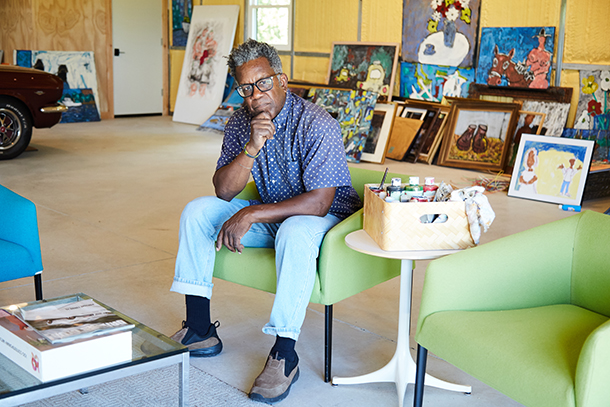
In this area, in the borough of Bethany, just north of the town of Honesdale, Wayne County’s county seat, the artist Glenn Pogue and his wife Monique own and run a 14-room inn; it’s one of three guesthouses installed in historic buildings they operate under their Akwaaba Bed & Breakfast Inns brand name. (The other two properties are located in Philadelphia and in Brooklyn, New York.)
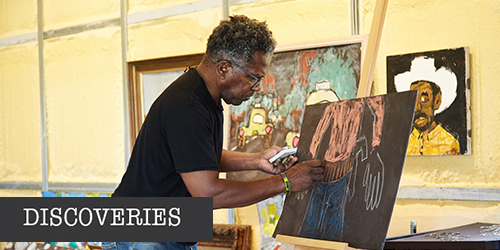
Pogue divides his time between Bethany and Brooklyn, and keeps an art-making studio in each location. Recently, Bill Westmoreland, brutjournal’s visual director, met and photographed Pogue at his Pennsylvania studio, where he had been working on paintings and drawings in various media. He told us about his trajectory as an artist and how, somewhat unexpectedly, he became an artist. As it turned out, art-making found Pogue just as much as this former television-production specialist discovered the satisfaction — and the expressive power — of creating art.
Pogue, who goes by the nickname “Glenzell,” was born in 1958 into a military family and brought up in Virginia. His parents came from South Carolina, and he is keenly aware of his Southern roots. After living on various U.S. military bases on the East Coast, his family settled near Fort Dix, an army base in southern New Jersey. His teenage years had begun.
Pogue told brutjournal, “In junior high school, I dreamed of becoming a professional photographer. I saved up my money from delivering newspapers, bought a Kodak Instamatic camera, and took pictures of just about everything. I especially loved taking pictures of birds. I had no clue about how to pursue a career in photography, so after high school, I took a few business classes at a community college and then joined the Navy, where I specialized in shipboard communications on submarines.”
After four years serving “mostly under water,” as he put it, Pogue moved to New York City and parlayed his Navy-acquired, technical communications skills into what became a four-decades-long career as a broadcast engineer with all three of the major television networks. (Today, in an era of cable TV, satellite TV, and Internet-based streaming, they’re often referred to as the American media world’s “legacy networks.”)
In New York, Pogue studied at Hunter College, from which he earned a bachelor’s degree in 1996 in film and television production, and in creative writing. As a young man in Brooklyn, he met and became friendly with the late Arthur Copedge, an older painter who had studied at Brooklyn College and was a member of the Art Students League of New York, in Manhattan. (Copedge died in 2010.)
It was Copedge, Pogue recalled, who served as a mentor and encouraged him to channel his creative energy into making art himself. As a result, Glenn took drawing classes at the League. He also routinely spent time with Copedge, who lived nearby in Brooklyn, observing the artist as he used oil paints to depict the life of the city on his canvases.
Pogue said, “I started experimenting with pastels and charcoal, while at the same time teaching myself to paint under Arthur’s watchful eye. He inspired me so much and helped me understand that a true artist has no choice but to create — an insatiable urge.”
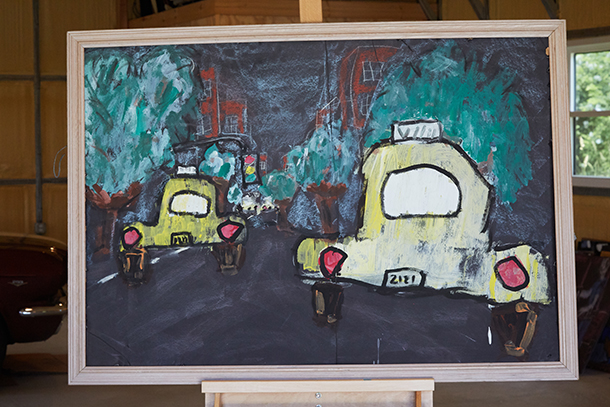
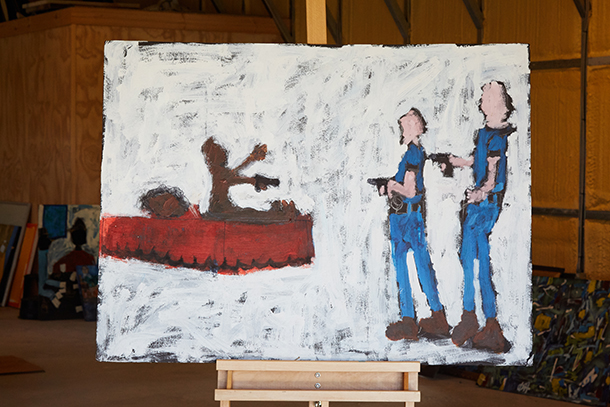
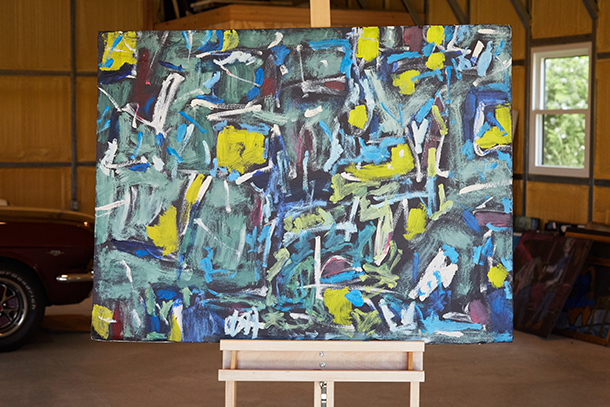
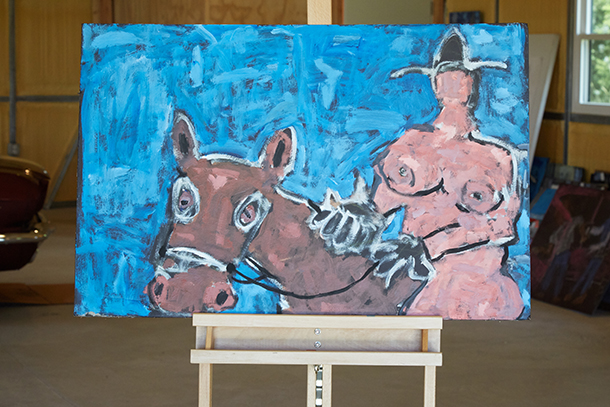
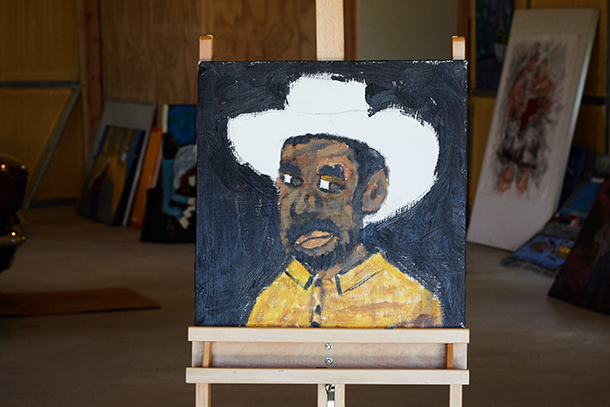
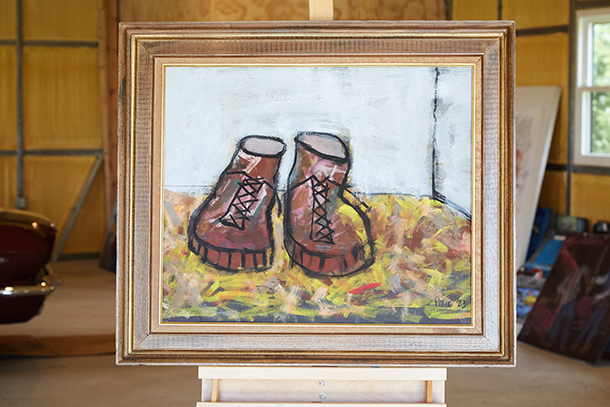
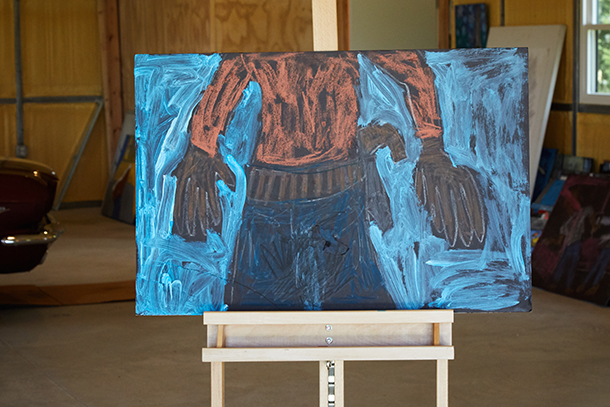
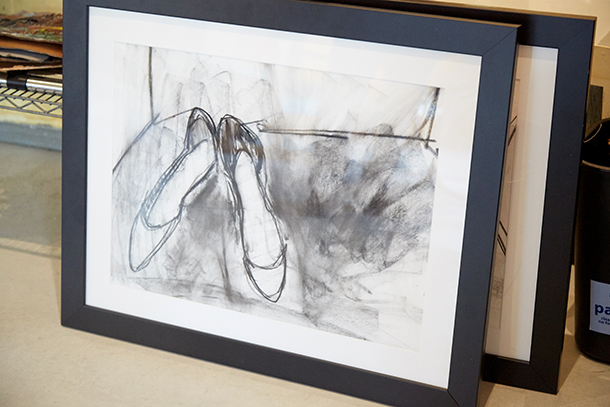
Over the years, in his own paintings and drawings, Pogue has produced cityscapes, portraits, and slice-of-life vignettes and souvenirs of the everyday: taxis barreling down an avenue; his own feet, apparently, as he lies on a bed watching television; a driver stepping out of his car, only to be held up at gunpoint; and a pair of high-heel shoes. He renders his subjects with a spontaneous-feeling, spare, unfussy line that captures their basic shapes and, economically, suggests their physical textures. His characteristically broad strokes of color, applied thickly or sometimes gingerly layered, give his compositions a sense of heft and, when piled on in assorted colors, some unexpected luminosity, too.
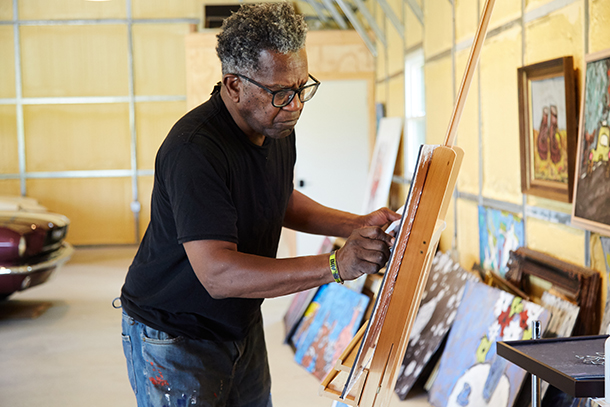
About his materials, Pogue, who finds inspiration in the work of such artists as Vincent Van Gogh, Claude Monet, and Romare Bearden, told us that, in addition to canvas, he has painted on cardboard and wood, among other support surfaces. He said, “I’ve even taken poster boards that were used to promote TV shows and worked on their back sides or right on top of them. Some of the colorful wires I used to create audio and video circuits in TV studios have also made their way into my wire sculptures.”
Pogue is also interested in and has been inspired by the work of the Los Angeles-based, black American painter Henry Taylor, who also was born in 1958. Taylor, who is especially well known for his portraits, has made paintings on cereal boxes, wooden crates, empty cigarette packs, suitcases, and other unconventional surfaces.
Feeling a sense of creative kinship with an artist like Taylor and bearing witness to the American scene of his own era, Pogue noted, “Recently, I’ve been using art to help me process the injustices levied upon black people in an increasingly hostile America. I painted a series capturing the tragic Breonna Taylor and George Floyd killings, for example. Then, on the opposite end of the spectrum, I’ve captured scenes that bring me peace, like my acrylic-on-canvas series of boats.”
The tranquility of the setting in which Pogue works at his studio in Pennsylvania might seem to belie the intensity of the seriousness of purpose he brings to his art-making now, as an artist who has traveled a long road. He observed, “At its core, I believe art’s role is to provide an outlet for the artist, but I [also recognize] that an artist can play a role in illuminating societal issues and creating conversations that can cultivate understanding and connection.”

Both Glenn Pogue and Bill Westmoreland will take part in the Wayne County Art Alliance’s 2026 Artists’ Studio Tour (Friday July 10 through Sunday, July 12). For detailed information about this event, during which artists open their studios to visitors and offer selections of their works for sale, click here.
[Scroll down to see more photos of Glenn Pogue’s artworks.]