


OUTSIDE HIS APARTMENT BUILDING NEXT TO A CANAL, THE SELF-TAUGHT ARTIST GERALD DALTON CREATED A MONUMENT TO HIS VISION OF HISTORY
Published on April 7, 2026
by Victoria Tischler
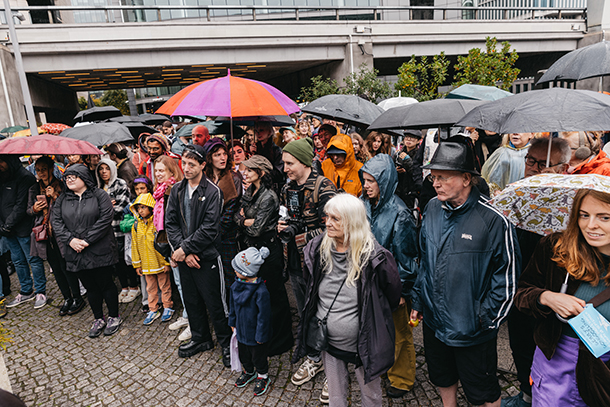
LONDON — On a rainy afternoon in September 2025, hundreds of people, including myself, gathered near London Paddington Station, huddling under umbrellas. We were there to take part in “Gerry’s Gongoozling,” a procession that would unfold along London’s Grand Union Canal to celebrate Gerry’s Pompeii, a hidden treasure and remarkable example of an urban visionary environment. (A brief geographical note: Grand Union Canal runs from the River Thames at Brentford, in West London, up to Little Venice, a well-to-do, quiet neighborhood in Northwest London; there, Grand Union Canal meets Regent’s Canal.)
“Gongoozling” refers to the leisurely activity of watching boats on a canal. As a London resident, I have long been fascinated by the city’s canals. The construction of Britain’s inland canals began in the 1800s and expanded during the Industrial Revolution, creating waterways to transport goods like coal, textiles, and pottery across the country. Nowadays, London’s 220 kilometers (some 137 miles) of canals are home to narrowboat dwellers, urban wildlife, and tow paths that are used by recreational walkers, joggers and cyclists.
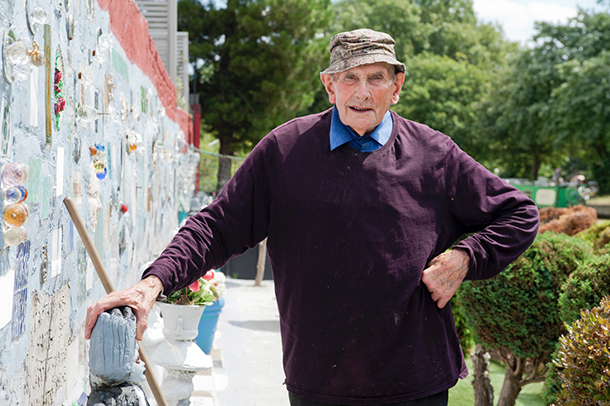
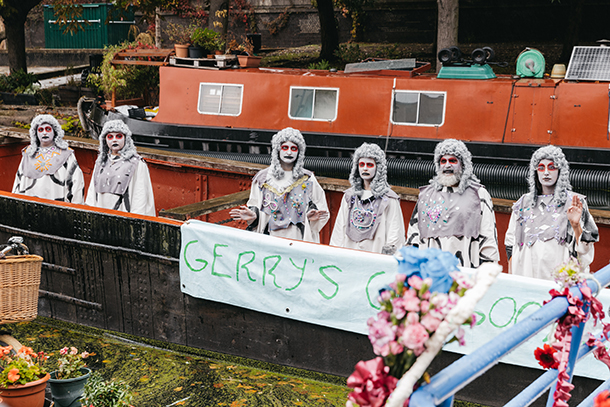
Gerry’s Pompeii was the creation of the late Gerald (“Gerry”) Dalton (born in Athlone, Ireland, 1935; died in London, 2019). It’s a secret garden and an immersive environment, accessible only via boat, which he created over a period of three decades. A lucky few of us Gongoozlers were ferried there across the Grand Union Canal via “Gerry Ferry” at the end of our rainy-day procession.
After leaving school in Ireland, Dalton spent time working on a farm and then served in the Irish Army. For a time, he worked for a wealthy colonel named Harry Rice and his wife, who inspired his love of history, mythology, and gardening. In 1959, Dalton moved to England, where he spent five to six years working on the railways, in London, in the parcel depot at Paddington Station and later at Victoria Station. Subsequently, he undertook a series of diverse jobs — factory worker, hotel porter, builder, and café assistant.
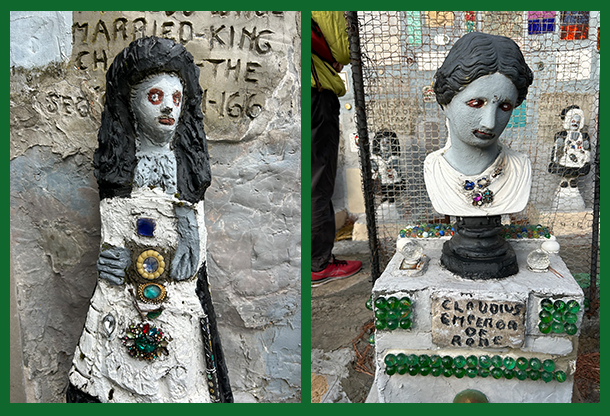
In 1996, after retiring at the age of 60, he began creating his imaginary Pompeii. This extraordinary environment, which still exists in the next-door garden of the flat Dalton occupied in a social-housing building, contains 115 statues. It’s an ensemble that represents the self-taught artist’s own unique version of history. He chose the subjects depicted by his statues based on their varied contributions to history. As Dalton said, all of his historical figures were “brilliant in their ways.”
The first statue he created depicts the Irish poet John Keegan (“Leo”) Casey (1846–1870). Dalton’s statues and busts also portray notable figures such as the Roman emperor Claudius; the British kings George IV (1762–1830) and George V (1865–1936); Frances Grey, the Duchess of Suffolk (1517–1559), who was the granddaughter of Henry VII and the mother of Lady Jane Grey; William Cavendish, the first Earl of Devonshire (1552–1626); and the Irish royalist and Jacobite soldier Richard Talbot, the first Earl of Tyrconnell (circa 1630–1691).
Lesser-known historical figures whom Dalton memorialized include Mary Gibson, the daughter of John Gibson, a 19th-century British architect who designed bank buildings, and the Fish Boy, an unknown male child who gazes into the canal. Dalton once noted that his favorite creation was his statue of Louis XIV, the 17th-century French monarch who commissioned the Palace of Versailles. Among the sculptures in Gerry’s Pompeii there is one of Dalton himself, “Gerry the Gardener.” He considered this piece a failure, stating, “[It] don’t look like me, but some people say it’s alright. Maybe it’s the way you look when you are 90.”
Dalton was inspired to create his collection of historical figures after visiting London museums and Buckingham Palace, where he watched the Trooping of the Colour, an annual ceremonial event featuring soldiers, horses, and musicians celebrating the British sovereign.
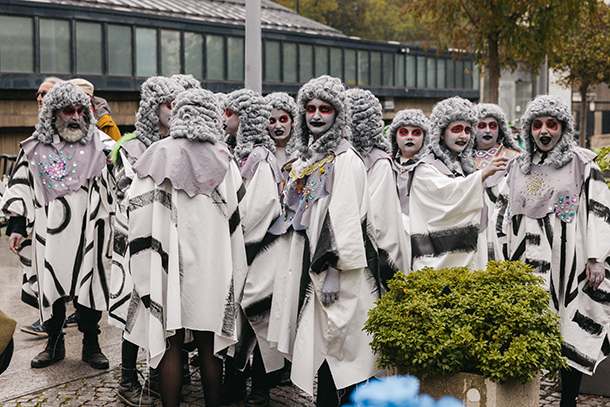
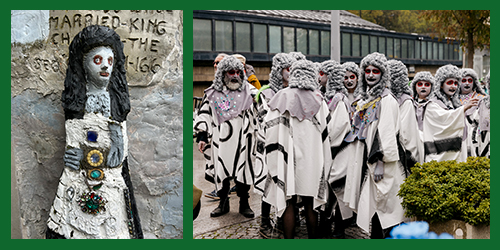
To create his sculptures, he worked from pictures of his subjects, in secret and usually at night. Most of them feature distinctive headpieces resembling the wigs that are traditionally worn by British High Court judges or the perruques of ancient French monarchs. Their gray, painted faces feature red-rimmed, startled-looking eyes and bejeweled garments made from ornate buttons and remnants of costume jewelry.
They look like soldiers standing in formation, frozen in time. Behind them stands a wall adorned with mosaic, plaques, gemstones, and other ephemera, such as a silver plate emblazoned with the phrase “Always nourish your garden.” Other key elements of Gerry’s Pompeii include carefully planted trees and shrubs.
Dalton was surprised by how much he managed to create and once observed that laboring on his art environment had kept him off the streets. He said, “They’ll be astonished [by] what they’ll find in my garden in years to come. It’ll be like Pompeii or something — Gerry’s Pompeii.” Dalton also made models of famous buildings, such as Buckingham Palace and St. Paul’s Cathedral, which he kept in his modest flat.
A plan led by Sasha Galitzine, a curator, to buy the late artist’s apartment and preserve it with his sculpture garden intact failed during the period of the coronavirus pandemic. Sadly, since his death in 2019, Dalton’s architectural models and some of his sculptures have disappeared under mysterious circumstances. Today, his sculpture garden is all that remains, and new tenants live in the flat that was once filled with the artist’s many creations. The only access available to would-be viewers of Gerry’s Pompeii is now via the canal waterway.
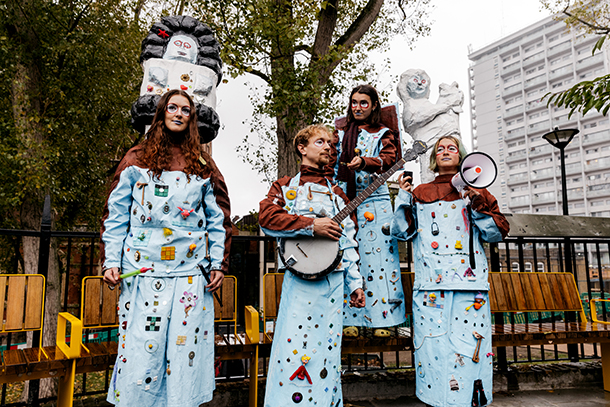
On the day of the Gongoozling event in which I took part, an array of artists and musicians entertained us as we slowly proceeded along a towpath toward Gerry’s Pompeii. At the strike of three o’clock, the parade began, the time, according to local legend, at which Gerry’s statues wake up. The procession included the “Muse-ical Statues,” a small legion of collaborating participants led by dancer/choreographer Patricia Langa and designer/clown Paulina Lenoir. Dressed in costumes, resembling Dalton’s statues, they began to march, as if awakened after a long slumber.
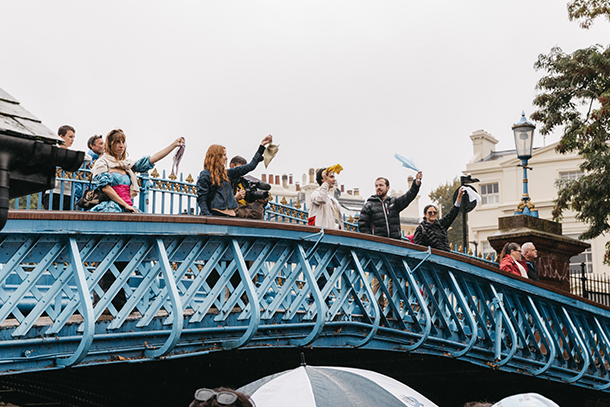
Our Gongoozling festivities also featured Hermione Spriggs and Kyle Berlin’s “Rats,” in which two performers wearing prosthetic noses with whiskers darted and wove through the crowd like the ubiquitous rodents that make London their home. The artist Amalia Pica’s “Waving at Boats” revived the nostalgic gesture of waving greetings with cotton handkerchiefs, which, for this event, had been hand-dyed by older people from a local community group. Band Batuke’s samba drumming led our Gongoozling procession with an upbeat, steady marching rhythm, a nod to the Afro-Brazilian diaspora that, over the years, has made West London its home.
Now carefully managed by a charitable organization called “Gerry’s Pompeii,” which is based in West London, Dalton’s creation is being preserved and celebrated. Under Sasha Galitzine’s direction, this art site now serves as a hub for community engagement in a part of London that has known high levels of social and economic deprivation. Gerry’s Gongoozling is one event that aims to foster community regeneration and cohesion. Today, Gerry’s Pompeii, the charity, has partnered with London Sports Trust to make the site more accessible by enabling visitors to make their way there via kayak or narrow boat.
Galitzine observed, “It’s incredible to see the excitement on kids’ faces when they arrive at Gerry’s Pompeii by boat. [For them,] it’s like a voyage into a faerie realm. The context of this otherworldly garden seems to really calm them too,” Galitzine said that, as she makes arrangements for school groups to visit Dalton’s art-filled garden, she is “trying to develop a new treasure hunt” to expose students to an “alternative history lesson” offered by the late artist’s sculptures.
Looking ahead, Galitzine notes, “Given Gerry’s Pompeii’s uniqueness as an artwork, but also within its context of residential West London, we’ve been exploring new forms of local ritual and tradition working with Gerry’s community. I feel there are so few opportunities now [for] people from all social, economic, and cultural backgrounds [to] celebrate together in the name of something like joy or the imagination, and Gerry’s [garden] can offer this.”
Galitzine said she hopes that Gerry’s Gongoozling may become a new, annual tradition, one that will allow the local canal to be used “as a dynamic and inclusive stage.” That ambitious vision for the future of Gerry’s Pompeii harnesses — and could help nurture — the liberating, transformative power of culture and creativity.
As an “alternative cultural heritage site,” as Galitzine describes it, Gerry’s Pompeii allows the public to question “whose artwork gets to be preserved and shared.” She said, “I hope it can be a dynamic platform [enabling] access to the arts for those who might not feel comfortable in more traditional institutions — a beacon of unselfconscious, unrestrained freedom to create.”

Victoria Tischler, a London-based psychologist and independent curator, thanks Sasha Galitzine, the head of the charitable organization that has been established to preserve and promote Gerry’s Pompeii, and Sophie Money for their contributions to this article.
To learn more about Gerry’s Pompeii, visit the site’s website, here.
The quotes from Gerald (“Gerry”) Dalton come from a conversation between the late artist and Roc Sandford, which took place in 2014, in West London.
Dalton quotes ©2014 Roc Sandford.
Photos courtesy of Victoria Tischler, Jill Mead, Lorcan Berg, and Gerry’s Pompeii.