

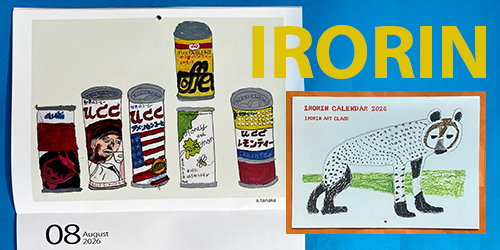
IN A TOKYO SUBURB, A SMALL WORKSHOP FOR SELF-TAUGHT ARTISTS HAS PRODUCED A COLORFUL 2026 CALENDAR

LED BY THE ARTIST TAKESHI TADATSU, IRORIN ART CLASS OFFERS A PLACE FOR CREATIVITY AND A VALUABLE SENSE OF COMMUNITY


Published on January 19, 2026


by Edward M. Gómez


TOKYO — Like any vast, dynamic metropolis, Tokyo is a place that is full of surprises and discoveries that are just waiting to be made. So it was that, last year, I ventured out to Tachikawa, a suburban town to the west of central Tokyo, where the Hanamidori Bunka Sentā (Hanamidori Cultural Center) may easily be found; it’s situated in Shōwa Kinen Park, just a few blocks to the north of Japan Railway Tachikawa Station on the Chūō train line.
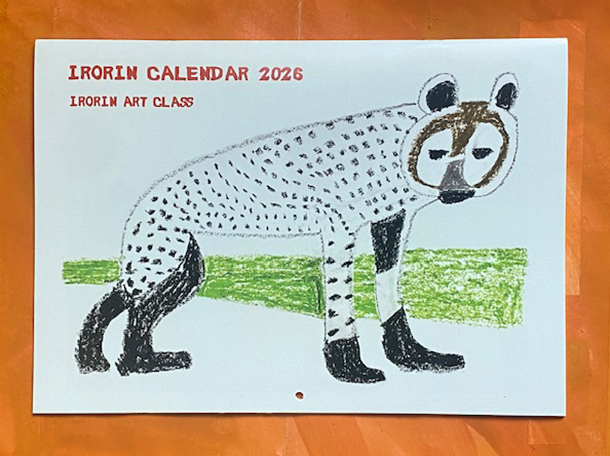
The cover of the 2026 calendar produced and published by Irorin Art Class. All photos by brutjournal

The cultural center is a large, modern building whose undulating, glass-wall façade encloses large, open spaces that can be used for crafts fairs, performances, workshops, exhibitions, and many other kinds of activities and events. The building also houses the Emperor Shōwa Memorial Museum, which focuses on the life of the Japanese monarch of the Shōwa era (1926-1989), who is better known outside Japan as Emperor Hirohito.

The artist Takeshi Tadatsu, who, in the past, spent several years in New York, where he was based in Brooklyn, serves as the director of Irorin Art Class.

At the Hanamidori Bunka Sentā, I saw an exhibition of artworks, mostly drawings on paper, made by the self-taught artists who take part in the activities of Irorin Art Class (Instagram: @irorin.artclass), a local art studio serving disabled people. Its director, Takeshi Tadastu (Instagram: @takeshi.tadatsu), is an artist who, in the past, spent several years living and working in New York, where he was based in Brooklyn, soaking up its vibe long before its name became synonymous with that of a hipster mecca known for its creative spirit and edgy attitude.

Today, eleven art-makers take part in Irorin Art Class’s activities; they all live in Tachikawa. In addition to Tadastu, the facility is run by five other staff members.

To date, the Irorin Art Class artists whose works I’ve seen in person have included Shūji Endō (60), Harumitsu Inoue (54), Shūji Kanbara (51), Akio Kurihara (60), and Shun Tanaka (51).

Despite the art workshop’s name, it is not a facility that offers art-making instruction to these participants per se; instead, following a protocol that is common in such institutions for disabled artists throughout Japan, the U.S.A., Europe, and other parts of the world, Irorin Art Class provides a workspace and materials for its members. They’re completely free to use their materials as they wish and to create whatever they might wish to produce. Tadatsu said, “Acrylic paints, pastel crayons, and colored pencils are some of their most common materials. They also use paper clay.”

From Irorin Art Class’s 2026 calendar: January features a luscious mountain painted by 60-year-old Akio Kurihara.

Above all, a place like Irorin Art Class offers its participants — and nurtures among them — a welcoming sense of community. This valuable aspect of this art workshop’s experience is especially meaningful in Japan, where, often, an individual derives a sense of identity and a sense of his or her place in society from his or her involvement with and relationships to various groups, from the family to classmates, work colleagues, or fellow members of clubs or sports teams.

“Each of the Irorin artists has developed his own style and his own expressive voice,” Tadatsu told me. More recently, he showed me Irorin’s new calendar for 2026, whose monthly pages feature reproductions of the five, above-mentioned artists’ colorful works. (To purchase the calendar, send an inquiry DM message to Tadatsu via his Instagram account.)

From Irorin Art Class’s 2026 calendar: January features a dark-colored animal — a big cat? — drawn by Shūji Kanbara (age 51).

Dipping into the 2026 calendar, one finds Kurihara’s picture of a mountain resembling a big, icing-slathered cupcake — could it be Mt. Fuji? — opening up the new year on January’s pages. February features Kanbara’s dark-colored animal — a big cat? — and some simply abstracted trees floating in a luminous white space. Endō is known for his energetic, abstract images; two of them appear on the pages for April and October. Tanaka’s line drawings of cars, including a small oil-delivery truck, appear in May, and Inoue’s large animal — a lumbering moose? — turns up on December’s pages.

The calendar serves up a selection of images whose draftsmanship is straightforward and effortlessly stylized, as each artist seizes upon and, apparently, has great fun trying to capture the essential outlines and textures of his subjects.

Irorin Art Class member Shūji Endō (age 60) likes to paint abstract images; here, a brushy composition appears in the calendar’s April pages.

Tadatsu told me, “Part of our overall space is used for the art workshop. Other institutions have larger spaces they can devote to art-making activities.” He notes that, while Irorin Art Class cherishes its independence, it is also hoping to drum up some support for its operating budget.


[Scroll down to see more artworks from Irorin Art Class 2026 calendar.]

The 51-year-old artist Shun Tanaka’s line drawings of cars, including a small oil-delivery truck, appear in May.
Harumitsu Inoue (age 54), has contributed an image of a large animal — a lumbering moose? — to December’s pages.
Another abstract image by Shūji Endō, this one in the pages for the month of October 2026.
In early 2025, an exhibition of some of Irorin Art Class’s artists’ works were exhibited at the Hanamidori Bunka Sentā (Hanamidori Cultural Center) in Tachikawa, a suburban town to the west of central Tokyo. In this photo, the exhibition area is on the left, where a viewer in a white coat can be seen examining some artworks.