

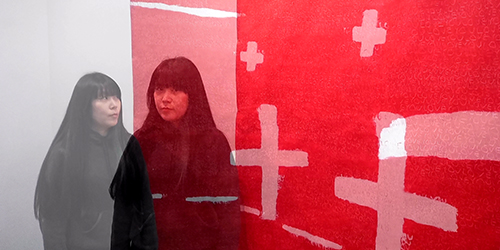
IKUMI KAKIHARA’S NEW WORKS, NOW ON VIEW: “A CAT HAS NINE LIVES”

IN TOKYO, AN ARTIST PRESENTS PAINTINGS AND OBJECTS FILLED WITH PUNK-SURREAL SPIRIT AND A WRY SENSE OF HUMOR


Published on December 17, 2025


“A Cat Has Nine Lives: Ikumi Kakihara Solo Exhibition”
Colony Minami Aoyama
Minami Aoyama 6-3-7
Minato-ku, Tokyo 107-0062
December 11 through 21, 2025


by Edward M. Gómez


TOKYO — It was the red that did it, a super-red that lured us to the gallery — a luminous scarlet that appeared in the photos the Japanese artist Ikumi Kakihara recently posted on her Instagram account (@ikumikakihara) and that turned out to be even more powerful and sumptuous when seen in person.

It’s the dominant color in evidence in her current solo exhibition at Colony Minami Aoyama in Tokyo. In fact, beside the black or white of a few objects on display that the artist has embellished with her chosen power red, it’s her current group of artworks’ only color.
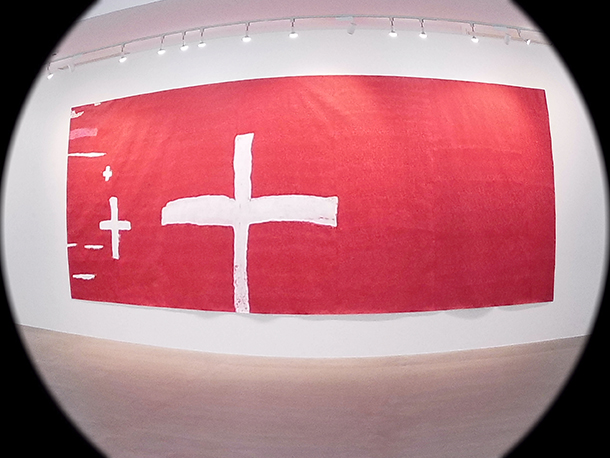
Ikumi Kakihara, “LOVE YOU,” 2025, a painting in acrylic on canvas measuring two meters high by five meters wide, now on view in the gallery exhibition “A Cat Has Nine Lives.” Photo by Edward M. Gómez

The young, Tokyo-based artist hails from a town in the Kansai region in the south-central part of Honshu, the largest island in the Japanese archipelago. Interested in art since an early age — as a child, she liked to draw — and inspired by hardcore music and the general punk aesthetic, after moving to Tokyo several years ago, Kakihara began exploring some new art-making ideas.

Earlier this week, at the gallery where her current exhibition, “A Cat Has Nine Lives,” is on view (through Sunday, December 21), Kakihara told me that she has not shown her art very often but that, with this new group of thematically related paintings and painted objects, there are some ideas she has been developing that she wanted to express using the signature language she has been developing. It’s marked by a simple palette of red and white, and the use of written words that serve as both design and communication elements in her compositions.

Ikumi Kakihara, close-up view of the surface of the painting “LOVE YOU,” 2025. Photo by Edward M. Gómez

Stepping into Colony Minami Aoyama’s one, big room from the gallery’s glass-walled, ground-floor entrance side, which looks out over a narrow lane, visitors immediately notice, filling the wide, opposite, interior wall, Kakikara’s “LOVE YOU,” a huge painting that is two meters high and five meters wide. It’s a blast of bright red punctuated, on its left side, by two white crosses and a few short, white, horizontal lines.

These marks could be read as plus and minus signs or as abstract elements. They float in the painting’s red expanse, giving its simple composition an illusion of spatial depth. Approaching this monumentally scaled painting and examining its surface closely, viewers will discover that it is covered with the English words “LOVE YOU” written out over and over again in plain, block letters.

Ikumi Kakihara, “NINE LOVE YOU,” 2025, a grid of nine paintings on paper, now on view in “A Cat Has Nine Lives.” Photo by Edward M. Gómez

Kakihara explained that, both conceptually and in concrete terms, this painting’s underlying structure is that of a grid consisting of two horizontal rows of five square units each. Each of the one-meter-square units of this work is being sold separately.

Similarly, in “NINE LOVE YOU,” each of the pieces of a nine-unit grid of red-on-white-paper “LOVE YOU” paintings is also being sold separately. The size of each of these paintings is that of a standard, A4 sheet of paper (the letter-size paper that is widely used in Europe and East Asia).

Two photos, above, of Ikumi Kakihara’s “LOVE YOU CAPITALISM,” 2025, a sashiko-embellished, black-denim jacket (made by the Supreme brand). Photo by Edward M. Gómez

“Throughout these works, you see the words ‘LOVE YOU’ or “FUCK,’” Kakihara explained. She said, “I don’t mean for these works to express any particular meaning. Instead, you can find in them whatever meanings you wish.” Whatever emotional-psychological reaction they might provoke, their art-historical affinities are rich — and unwitting, too, for Kakihara noted that she had no other artists’ works or any particular art styles in mind as reference points when she was making the current exhibition’s paintings and objects.

Still, they gently evoke the playful humor of Fluxus art of the 1960s and 1970s, as well as punk’s take-it-or-leave-it, in-your-face aesthetic. Here, though, that spirit feels somewhat tame as its penchant for provocation is tempered by the simple elegance of Kakihara’s spare design sense.

Ikumi Kakihara’s “LUXURY HATE ME,” 2025, a sashiko-embellished pair of black-leather shorts. Photo by Edward M. Gómez

For example, in a hand-embroidered, Supreme-brand, black-denim jacket (“LOVE YOU CAPITALISM”) and pair of black-leather shorts (“LUXURY HATE ME”), the artist uses sashiko to cover these garments in white or in white-and-red thread with the words “LOVE YOU” or “FUCK.” (The traditional Japanese sashiko technique uses simple running stitches, usually made with white thread, to produce structured patterns that simultaneously mend and give new life to time-worn fabrics.)

Ikumi Kakihara’s “TOILET SEAT” (left) and “SLIPPERS” (right). Photo by Edward M. Gómez

In Kakihara’s denim jacket and leather shorts, punk attitude meets fine handiwork. In the artist’s painted, everyday objects — a pair of cloth slippers, a toilet seat (from a very good brand, too: it’s a TOTO), and antique, hanging lamp — the spirits of Fluxus, punk, and even surrealism all seem to converge and help shape the ambiguous aura these artworks exude.

The artist Ikumi Kakihara and her “PENDANT LAMP.” Photo by Edward M. Gómez

Toward the end of our brief interview at the gallery, Kakihara leaned over to jot something down in my notebook, using a chair as a table, and I noticed that she had sashiko-treated an area on the back side of her own black jeans.

“LOVE YOU. LOVE YOU. LOVE YOU,” that little patch of stitching declared.

Kakihara’s art might knock viewers around with a tug of war between its word elements’ contrary-sounding messages but, apparently, it always knows, with a positive vibe, exactly where to land.


[Scroll down to see more photos.]

Sashiko stitching on the back side of the artist Ikumi Kakihara’s own jeans. Photo by Edward M. Gómez
Kakihara standing next to her large painting “LOVE YOU,” 2025, which is now on view in the exhibition “A Cat Has Nine Lives.”Photo by Edward M. Gómez
Kakihara examines a copy of the recently published, fourth volume of the brutjournal annual (2024-2025 edition), the online magazine’s yearly, anthology-format, printed book. Photo by Edward M. Gómez