

CUTTING THROUGH THE FAIR’S FESTIVE CLUTTER, SOME DELIGHTFUL DISCOVERIES EMERGE
Published on March 21, 2026
By Edward M. Gómez
NEW YORK — Pow! Someone whacked a giant piñata, and out poured all the color, excitement, eager sense of discovery, and endless cascade of surprises that are the essential ingredients of the Outsider Art Fair.
Back off, Basel, and vattene, cara Venezia!
It might be comparatively smaller, but this gathering, in New York, of passionate admirers of art made by self-taught creators whose life experiences have compelled them to produce paintings, drawings, sculptures, and other concoctions that, often, are hard to classify with familiar labels, is the art world’s liveliest, annual fiesta in art-fair form.
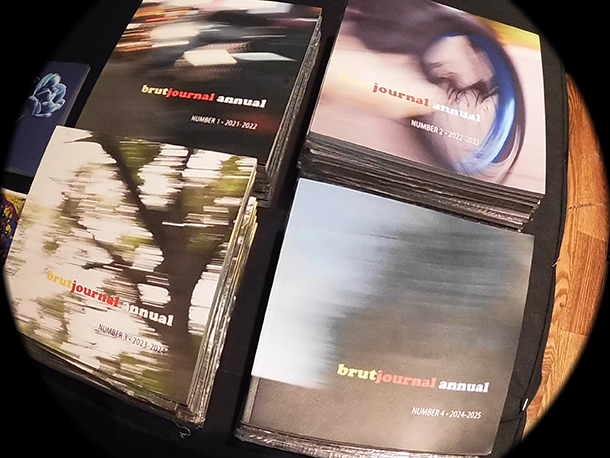
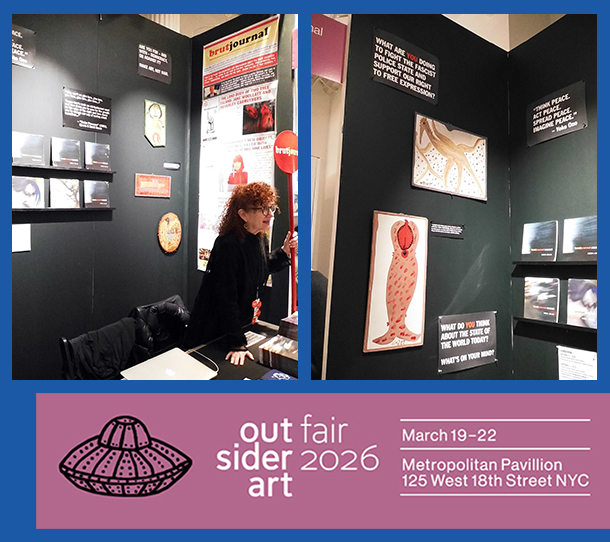
This year’s OAF is taking place from Thursday, March 19, through Sunday, March 22. Once again this year, brutjournal is serving as one of the fair’s official media partners.
This year’s event welcomes 68 exhibitors, mostly from the United States but also from Europe and Japan. Within the fair, too, “From the North,” an exhibition curated by the Toronto-based art dealer Patricia Feheley and Mark London, the director of Galerie Elca, in London, features works from Kinngait, Canada (formerly Cape Dorset), the home of Kinngait Studio. That facility, established in 1958, is the only Arctic art-making studio whose participating artists have continuously produced prints and other kinds of works since its inception.
This year’s fair comes at a time when awareness of the phenomenon of outsider art and of art brut, its related field of art appreciation, investigation, and classifying of the creations of autodidact artists living and working in marginalized circumstances, is perhaps more widespread than ever, at least within the broader, international art world. However, unfortunately, a lot of misunderstanding about the related, overlapping fields of art brut and outsider art persist.
(That misunderstanding and the task of clarifying it are the stuff of an ongoing effort some specialists continue to pursue, despite the challenge it poses. Art brut and outsider art are not styles or movements or artistic schools. It’s deeply frustrating when, every year at the fair, inevitably, I hear some uninformed visitor refer to the works on display as “crazy people’s art” or some young artist say to his or her companion, “Wow! I can’t wait to get back to the studio and make a painting in the outsider-art style!”)
Meanwhile, in some ways, a core component of the specialized market for outsider art is actually shrinking. Today, only a handful of so-called legacy galleries, those that, for decades, have focused on this particular sector of the broader art market and have played a key, collective role in developing it, are still in business. Over the years, some of them have folded the showing of contemporary art into their programs — out of genuine interest, to be sure, but perhaps also prompted by the realization that the sale of outsider art alone might not be enough to keep the lights on.
As a result, in recent years, fairs and other venues presenting new discoveries in the outsider art category have cast their nets widely, bringing into the fold some merchandise of dubious aesthetic value that sometimes is not characterized by the most striking evidence of technical innovation or artistic vision; that’s a big deal in a field that tosses the word “visionary” around rather loosely when describing many a self-taught creator.
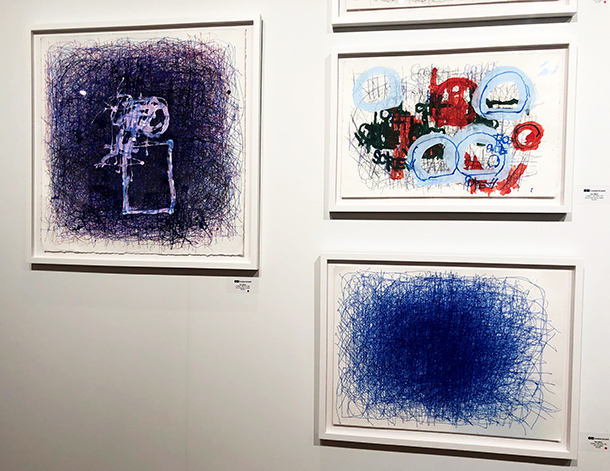
At this year’s fair, a little digging can go a long way. In the booth of Creative Growth Art Center, one of the leading art-studio programs in the U.S. for disabled art-makers, Dan Miller’s scratchy abstractions look as vibrant and feel as assured as ever. Creative Growth, which is now celebrating its 50th anniversary under the leadership of Sunny A. Smith, its new executive director, long ago made pioneering efforts to professionally promote some of its artists’ works to market. Today, the works of such Creative Growth artists as Miller, the late Judith Scott (1943-2005), and the late Dwight Mackintosh (1906-1999) are as well-known internationally as they are within the world of outsider art.
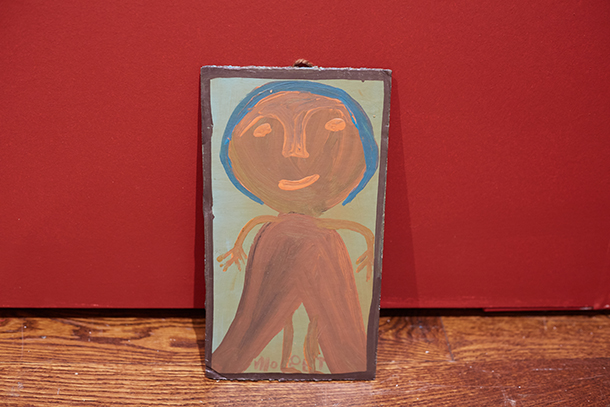
Ruffed Grouse Gallery, a small venue in the town of Narrowsburg, in upstate New York, has a batch of early paintings by Mose Tolliver (1919-2006), an iconic self-taught artist of the American South whose imagery featured animals and the men and women he observed around him in his rural community. Their exaggerated bodies — and, sometimes, Tolliver’s bluntly erotic depictions of his subjects — give the artist’s pictures an alluring earthiness and a particularly quirky charm.
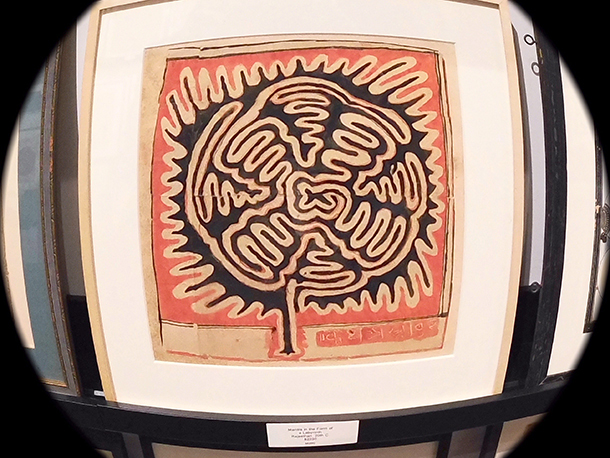
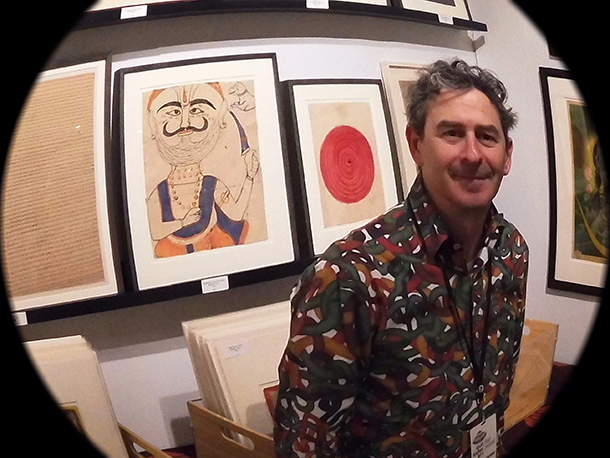
The Brooklyn-based dealer Alexander Gorlizki has long kept an art-making studio in Jaipur, in northwestern India. There, various local artists create works on paper, often preferring to remain anonymous when Gorlizki brings their intensely colored, Tantric drawings to market. At this year’s OAF, his Magic Markings booth offers a large selection of these works, with their austere geometric compositions. (Instagram: @magicmarkings_indiandrawings)
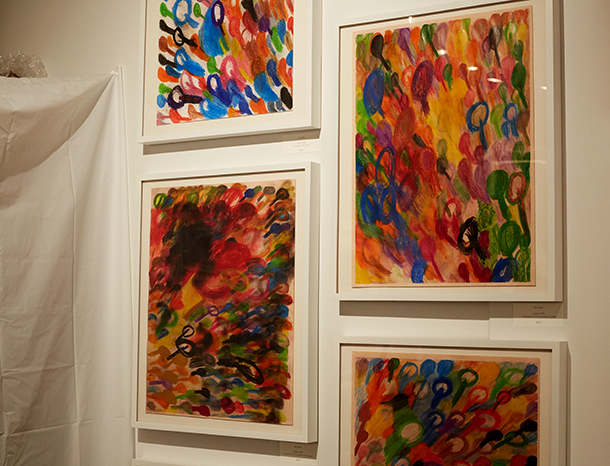
In the booth of the Center for Creative Works, an organization that operates two art-making workshops for disabled people in the Philadelphia area, the brightly colored abstractions in colored pencil on paper of the artist Billy Bolds feel irrepressibly joyous.
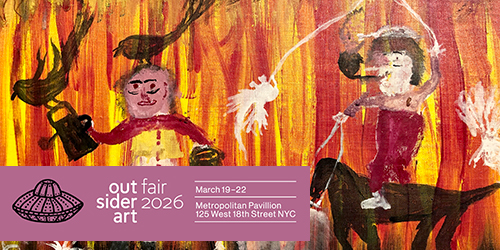
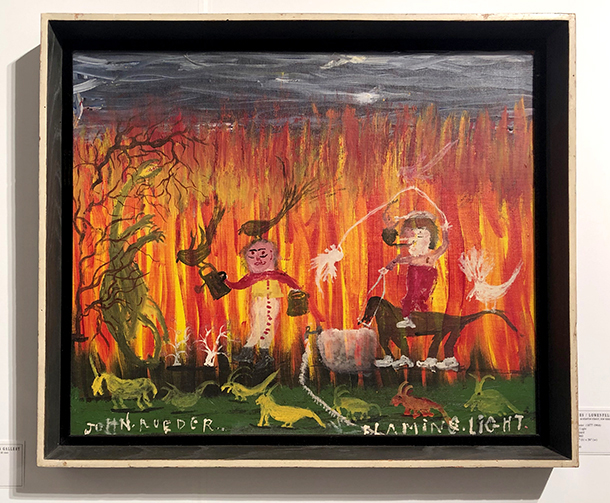
Among the offerings in the booth of Powers/Lowenfels Gallery, which is located in downtown Manhattan’s Lower East Side district, one small painting, with its fiery, red-orange palette and peculiar farm scene, stands out.
Titled “Flaming Light,” it’s a picture in oil on board by John Roeder (1877-1964) featuring a man on a horse — or a big, long-tailed dog with white feet resembling chunky sneakers? — and a woman with a watering can (large birds are perched on the can and on her head) standing in front of a row of tall-growing plants. Are they burning corn stalks? Roeder’s entire composition seems to be deliciously on fire. Feel the heat!
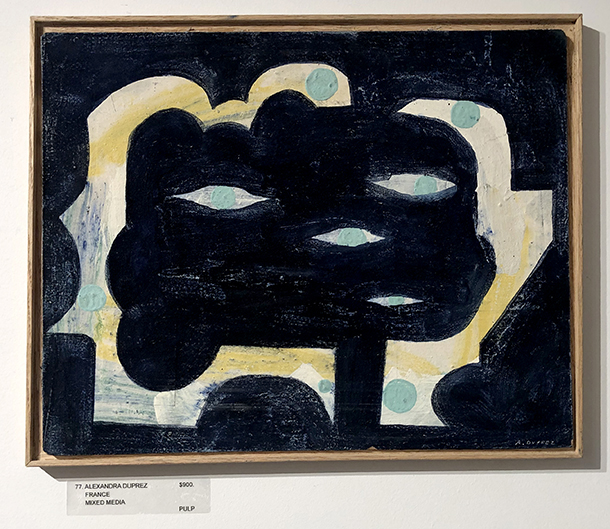
Pulp, a gallery based in Holyoke, Massachusetts, is presenting a handful of small, abstract works by the artist Alexandra Duprez (born 1974), who is based in France. Duprez was expelled from a university at which she was studying when she was 20 years old. She threw herself into her art-making, creating abstract compositions that feel mysterious, as though they’re revealing their messages with hesitation through their layers of overlapping colors and abstract or silhouetted human forms. In her palette, black, dark blue, and scarlet red play prominent roles.
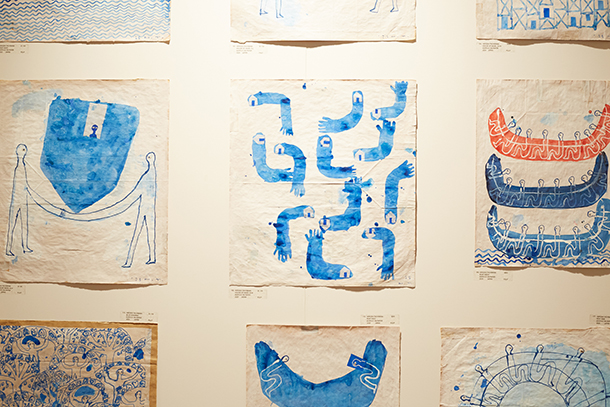
Pulp is also showing paintings made on scraps of paper bags by Hiroshi Tachibana, a self-taught artist who works as a forklift driver at the port of Kobe, a large, commercial city in south/southwestern Japan. With their gentle color washes and clever plays of form in images of boats, trees, and human figures, Tachibana’s pictures call to mind the spirit of the work of such artists as Jean-Michel Folon or Paul Klee, whose art was known for its formal playfulness and deep sense of humanism.
There is much more to explore and discover at this year’s fair.
We’ll be back again with more news and notes. Follow brutjournal’s Instagram posts, too, for quick visual dispatches from this year’s OAF. (Instagram: @brutjournal)
The big piñata has been busted open, and we’re eagerly grabbing the treats it has released!