
THE ART PRESERVE BUILDING SHOWCASES STATUES CREATED BY THE LATE PIZZAMAKER AND FOUNDER OF A VERNACULAR, CULTURAL-HERITAGE MUSEUM
Published on July 10, 2026
“Silvio Barile”
John Michael Kohler Arts Center
Art Preserve
3636 Lower Falls Road
Sheboygan, Wisconsin 53081 U.S.A.
Artworks on view from April 26, 2026 through October 2026 (check venue’s website for exact, to-be-announced final day of current presentation)
by Sarah Fensom, brutjournal’s Los Angeles-based, U.S.A. West Coast bureau chief
Silvio Barile (1938-2019), an Italian immigrant who arrived in the United States in 1954, went on to turn the pizzeria he owned in Redford Charter Township, a suburb to the northwest of Detroit, Michigan, into a museum of Italian heritage, which he operated over a period of many decades.
Barile called his little institution “The Italian American Historic Artistic Museum.” Among its murals, photographs, and assorted tchotchkes representing Italian and American art and pop culture were numerous statues the baker and pizzamaker had created himself. These large-scale, painted-concrete works featured many of those other objects’ same themes. Barile selected the notable human figures, architecture, and events to which these works referred from a long period of history dating from antiquity through the early 21st century. Like Barile’s museum, the quantity of the sculptures he produced expanded over time; as they grew in number, they dominated ever more space inside his restaurant, on its back patio, and on the acre of land that spread out around it.
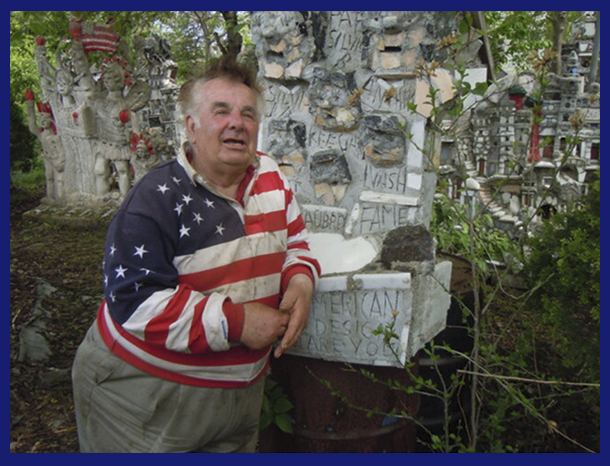
(See an entry about Silvio Barile’s Italian American Historic Artistic Museum on the website of SPACES, an organization that has documented many site-specific art environments created by self-taught artists around the U.S.A. and overseas.)
Barile grew up in Ausonia, a small, medieval town in the Lazio region of central Italy; in 1960, a few years after arriving in the U.S.A., he settled in Michigan. There, he worked at a local bakery before opening Silvio’s Rita Pizzeria and, shortly thereafter, began developing his “museum.” Barile’s pizzeria stopped functioning as a restaurant in 2002, but its founder continued operating his museum until his death in February 2019.
The following year, Barile’s property was destroyed, but in 2021, the John Michael Kohler Arts Center (JMKAC) of Sheboygan, Wisconsin, whose collection-building and exhibition-making focus on the work of site-specific environments created by self-taught and contemporary artists, acquired three of Barile’s statues. Later, communications with Barile’s family led to the Wisconsin museum’s acquisition of eight more of the late pizza chef and art-maker’s statues.
Earlier this year, the JMKAC put Barile’s statues on view at its Art Preserve, a new building that opened just a few years ago. Functioning simultaneously as a storage warehouse and as an exhibition venue, the Art Preserve displays artists’ works in large, glass-enclosed cases and curated installations. This presentation marks the first time Basile’s creations have been presented away from their original setting in the late artist’s restaurant/museum. The JMKAC Art Preserve’s holdings of Basile’s works is the largest group of these sculptures that still exists.
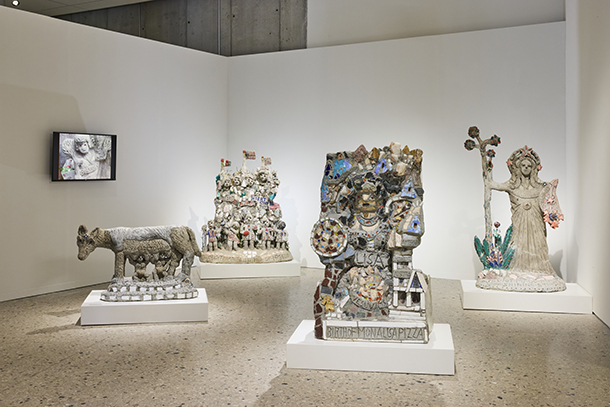
Laura Bickford, a curator at the JMKAC who oversees the Art Preserve, told brutjournal, “What’s really unique about our collection is that we collect artists’ environments. At this point, we have more than 40 environments represented [among our holdings]. In Silvio Barile’s case, we have all that’s left [of the works he produced], and there is no original reference point for the site [from which they came].”
Bickford noted that very little from the interior of Barile’s Italian American Historic Artistic Museum survived its demolition, and that, today, even though the late artist’s family members and friends do own some of his statues, the majority of his artworks were lost when his Michigan property was torn down. As a result, the Barile sculptures that are now on exhibit at the JMKAC’s Art Preserve offer a rare testament to their maker’s vision as artist and as the founder-curator of his now-defunct, vernacular museum.
Bickford never had an opportunity to visit Barile’s Italian American Historic Artistic Museum herself but from the descriptions of the site her colleagues who did see it in the past have shared with her and from her examination of surviving photographs and videos of the site she has acquired a good understanding of its history and character. Of her familiarity with the distinctive place Barile created over a period of many years, she said, “It’s not the same as [having been] there, but I’ve been able to get a sense [of the place]. The most common word I’ve heard from those who saw it has been ‘overwhelming’ [with regard to] both its interior’s collage elements and to the sprawling, amusement-park-like backyard [that was located] behind the pizzeria.”
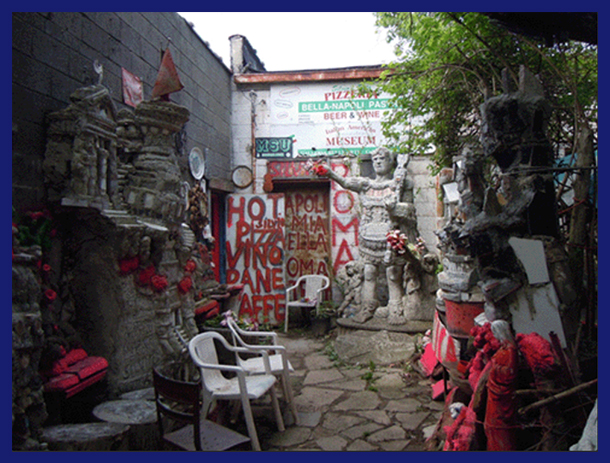
Photos show that the interior walls of Barile’s pizzeria/museum were packed with newspaper and magazine clippings, postcards from Italy, and artificial flowers. More flowers in vases, assorted Italian souvenirs, and knickknacks were plentiful, too. Outside, on a backyard patio, stood clusters of statues, some of which were 20 feet tall. Those hulking objects could not be easily moved, so, typically, Barile left them standing in the same spots in which he had crafted them. Over time, he filled in the spaces around them with his newest creations as he produced them.
Bickford said, “The statues were situated in packs and very tightly installed. A variety of other materials were just scattered around them, so everything had a super-dense feeling.”
The lion’s share of the archival photos Bickford and the JMKAC now have available for study came from one of Barile’s friends. Bickford observed, “There are a lot [of them] from over the years, but I don’t think they were intended to serve as a document [of the site Barile developed]. It’s not as though they go square by square around the [site’s] space but they do give a sense of what was there.”
Barile left no notes or records indicating the sources of the wide array of ephemera that filled his museum or when each item he exhibited had been added to its sprawling collection. Now on view at the Art Preserve, however, is the film “Silvio: A Story about Art and Pizza” which offers a vivid look back at its subject’s life and art-making activity; it shows him producing his sculptures and also making a trip to his native Italy after many years in the United States.
First presented at the Cranbrook Art Museum in Bloomfield Hills, Michigan, in 2002, the film was made by Matt Cantu, Kathy Vander, and John Prusak. About it, Bickford noted, “There’s an amazing part in which we see Silvio making pizza in his pizzeria — he’s using an industrial mixer, tossing and kneading the dough, and slapping on sauce and toppings.” “Silvio” cuts back and forth between Barile preparing food in his restaurant and working on his sculptures in its backyard. Bickford added, “We see him mixing concrete, and then slapping on stones, marble, and jewels. You really get a sense of his creative impetus, which was coming out [both] in the pizza and [in] the sculptures.”
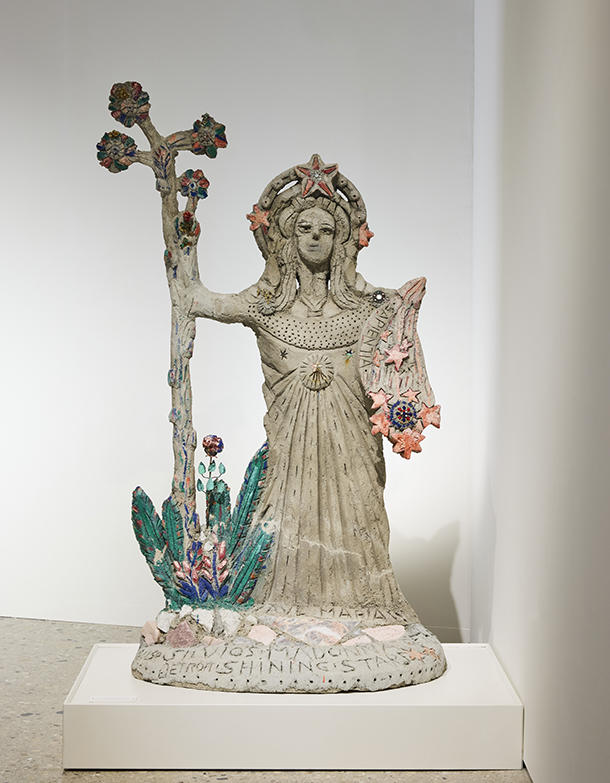
As an artist, Barile might have been self-taught but he was not naïf. As Bickford noted, he regarded his statues and the overall environment-as-art into which he transformed his restaurant as a genuine “artistic practice” that reflected “a particularly Italian” artistic heritage. She said, “He never said this explicitly, but I think he used concrete because that’s what was available. I think his real references were the famous, Renaissance-era marble sculptures that are found in Italy, and that he was trying to align himself with its history of monumental outdoor sculpture.”
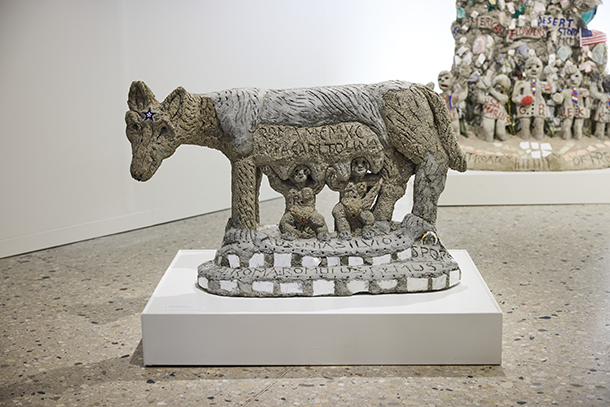
Barile’s art could be seen as didatic; apparently, by prominently exhibiting his sculptures in his restaurant/museum, he sought to educate his customers about his homeland’s history and cultural legacy. This is evident in his sculpture depicting the fabled shewolf that suckled Romulus and Remus in one of ancient Rome’s well-known, mythical foundation stories. With its multiple textures and colors of concrete, and its use of negative space, this is one of Barile’s most ambitiously structured works.
Through his art and his “museum” housed within a pizza restaurant, Barile attempted to honor Italy’s cultural achievements. At the same time, his relationship with his native country was not an easy one. Bickford explained, “He had fled war and fascism, and he had [endured] a very traumatic childhood in Italy, so while he was a proud Italian, he was also very happy to be in the United States.”
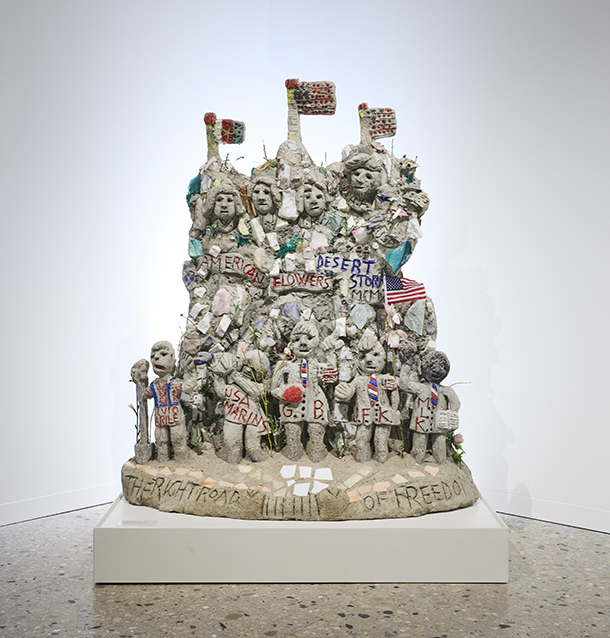
Thus, patriotic American themes can also be detected in his art and were reflected in the assorted pictures and trinkets he displayed in his museum. American political and pop-cultural figures, as well as American military insignia find their way into Barile’s work, where they blend with Italian imagery in interesting ways. In his pizzeria’s backyard space, Barile created what he called his “American Forum.”
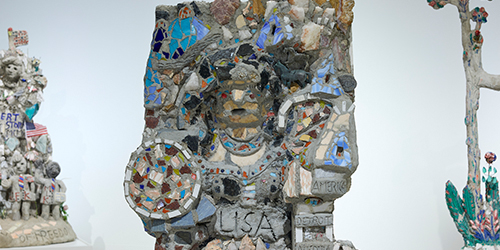
Bickford told me, “One of my favorite works in our collection is a pantheon of figures that includes George W. Bush, Martin Luther King, Jr., John F. Kennedy, a personification of the U.S. Marines, and Silvio Barile himself.” In his art, Barile evoked local Michigan themes, too, referring to the city of Detroit or the Detroit Tigers baseball team. One of his works, taking its inspiration from the Leaning Tower of Pisa, offered up a “Leaning Tower of Detroit.” On view in the Art Preserve’s current presentation is a bust of a woman that is surrounded by densely laid-out marble pieces whose inscriptions say, “America,” “Detroit,” “Ausonia,” “U.S.A.,” “Vesuvius,” and “Birth of Mona Lisa Pizza.”
To make his sculptures, Barile began by using rebar (steel rods) to construct their supporting armatures. He would then use chicken wire or other materials around their steel bases before covering these emerging volumes with thick layers of cement. Barile would then incise and draw his sculptures’ different features into the concrete, and sometimes coat it with thick washes of paint. Barile would stick a variety of materials into his developing sculptures while their cement was still wet. Among them: pieces of costume jewelry, artificial flowers, and large chunks of marble and granite that he procured from a nearby supplier of kitchen counter tops.
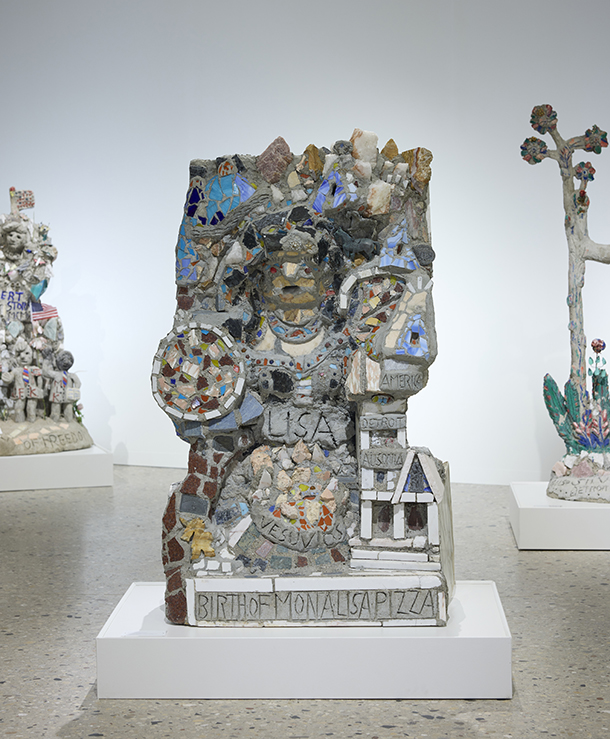
Barile routinely patched up and repaired his statues as they aged. Bickford sad, “Things would fall down, and he would just patch it or stick something else back in. You can see in our collection examples of repairs he made. He wasn’t overly concerned with matching the concrete — he wasn’t precious about it. To do a lot of the conservation on these statues, we worked with Mark Whitten, who is a concrete artist himself. It was great to have someone who understood the material and also the ethos of Silvio’s work.”
Through her research, Bickfod learned that, in the Michigan town where Barile spent so many years of his life, the late restaurant owner and founder of a deeply personal kind of culture-honoring “museum” is still fondly remembered.
Of Barile, who, while working at his restaurant, was known to spontaneously break out singing opera melodies, she said, “A lot of people still talk about Silvio — about his personality and the way he ruled over his domain, singing and feeding his friends and customers. He wanted to [share with] Americans the cultural, philosophical, and literary legacy of Italy, which was sort of wonderful.” The evidence of that creative effort now lives on in the Barile works that have found a permanent home at the John Michael Kohler Art Center’s Art Preseve.