
A DEMOCRACY-SUPPORTING ART-MAKER WHO USUALLY WORKS WITH FIBER HAS CREATED A LIMITED-EDITION COMPENDIUM OF NOW-PROSCRIBED WORDS AND PHRASES
Published on February 28, 2026

by Edward M. Gómez
In the beginning, there was the word.
Later, under oppression, came the rejection of many words.
Today, in the self-styled land of the free and home of the brave, the use of certain words has been banned by the henchmen of its ruling, fascist regime.
You might be surprised to learn that, among the words the thought police and sycophantic servants of the U.S.A.’s oranged-faced Dear Leader have declared unsuitable for use in federal-government documents, communications, or publications, or on the websites of the government’s various agencies, are such common, anodyne terms as “equality,” “identity,” and “women.”
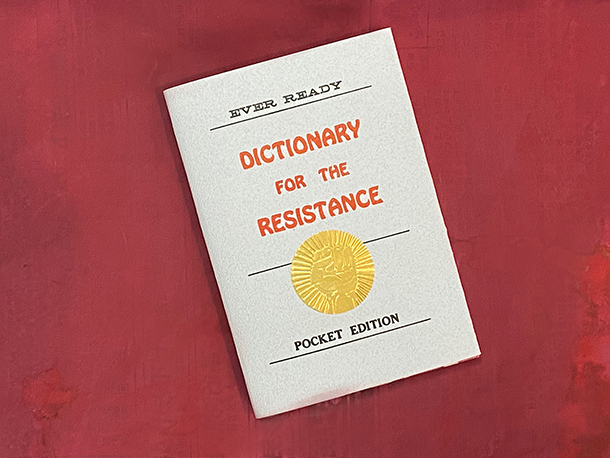
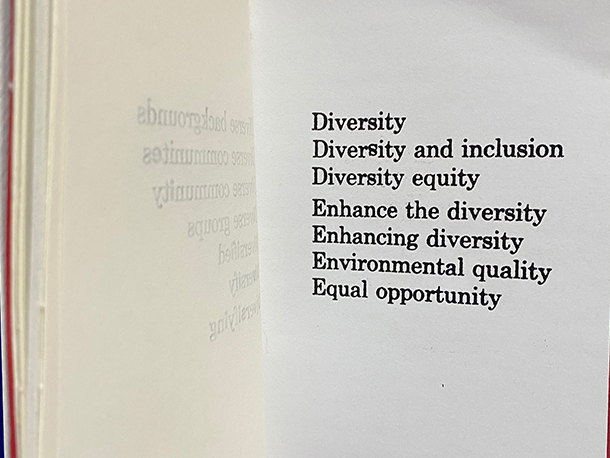
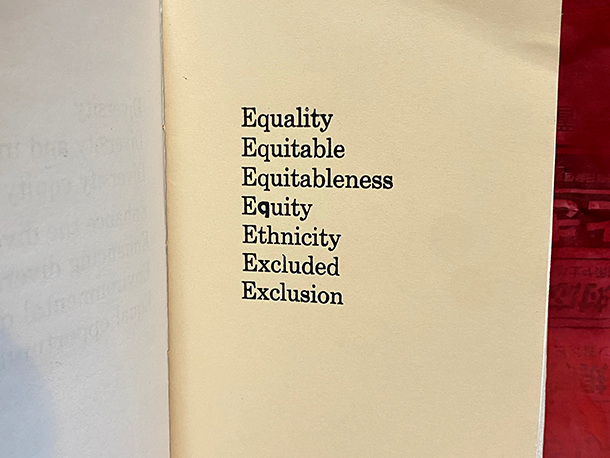
Recently, the artist Paula Kucera (Instagram: @whitebarnfarm) created The Dictionary of Resistance, a limited-edition artist’s book containing many such words and phrases, which the United States’ current ruling regime has banned. This project was something of a creative departure for her from the artistic activities she normally has pursued. That’s because, for many years, Kucera, who lives on a sheep farm in New Paltz, New York, north of New York City, primarily has worked with the wool yarn she has produced there.
She told brutjournal, “About 25 years ago, I started a sheep farm with the intention of bringing the farm-to-table ethos into the world of clothing. I knew nothing at the beginning; I learned as I went. Over time, I built a vibrant fiber community in the Hudson Valley, and I’m deeply proud of that. I ran a shop and teaching facility and offered many classes, but when the coronavirus pandemic hit, it became too difficult to sustain. I also realized that I needed a break. That was when I returned to painting.” Today, Kucera still produces and sells her wool yarn, but on a smaller scale.
She said, “I never chose to be an artist. I think I was simply born one. Deep consideration of the world around me has always been part of who I am, and at some point, probably around the age of ten, I decided to express that physically. I’ve never had a formal ‘art practice.’ Instead, I’ve tried to lead a creative life. I did attend art school — it was a strange ride — but that’s where I fell in love with painting.”
About her book project, she explained, “The Dictionary for Resistance began when I read a list of words that were reportedly being eliminated from the vocabulary of the current administration — words that, if used in government proposals or communications, could jeopardize acknowledgment or funding. They were also being removed from existing documents, effectively altering the historical record. One of those words was ‘women.’ I can’t fully describe my reaction — my head nearly exploded, I was so overcome with emotion.”
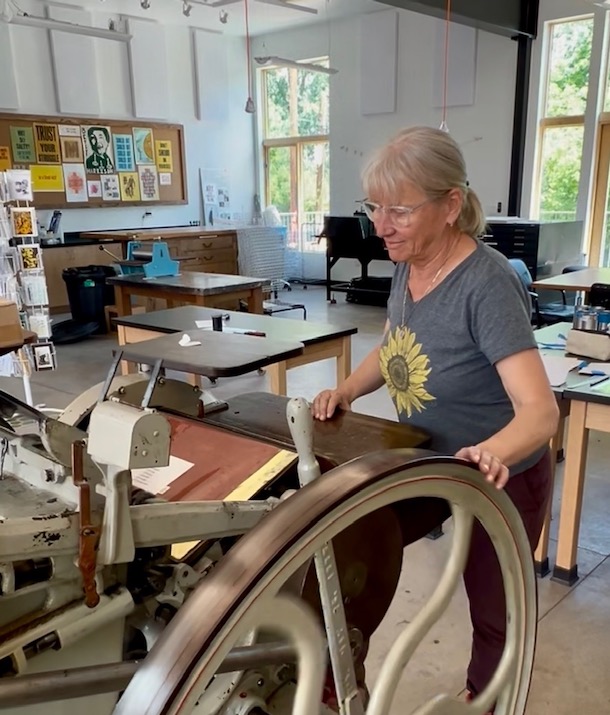
Around that time, Kucera had acquired a house in Mancos, Colorado, a town located near the Four Corners, a physical spot in the continental U.S.A. where the borders of four states — Colorado, Arizona, New Mexico, and Utah — meet at a single point. In Mancos, Kucera discovered a printing shop that supports the work of artists.
She recalled, “I knew I wanted to get involved there. It quickly became clear what I needed to do: create a book centered around those banned words. It was a way of marking the moment, of putting my energy into something tangible. I didn’t know exactly how it would be useful — only that I needed to give form to my rage.”
Producing The Dictionary for Resistance marked Kucera’s first-ever foray into the field of limited-edition artists’ books, distinctive publications that are simultaneously regarded as books and as works of art.
About her book, she noted, “It’s a rustic little book, full of imperfections, full of learning. It was made in the moment, without extensive preparation, and that rawness feels essential to it. It is truly an art piece. My goal was simple: I couldn’t let this time pass without responding in a personal way. If others felt the same, I was happy to share it with them. I never anticipated how many people would want a copy.”
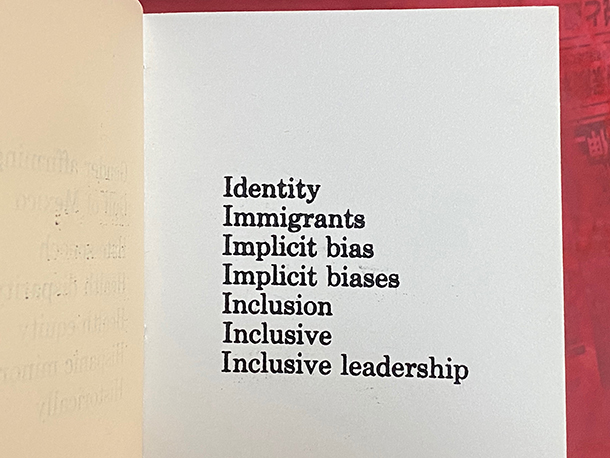
Now Kucera is thinking about trying to find a mainstream, so-called trade publisher who might be interested in producing, distributing, and selling an edition of her book that would be aimed at a wide audience.
She observed, however, that publishing her book in a mass-audience, commercial edition could “change the piece” and cause it to “become something else.” She said, “So now I’m exploring how to expand it while keeping its vitality. Perhaps it will include additional sections as the list of words grows, or offer pathways to action for those who feel moved to amplify its message.”
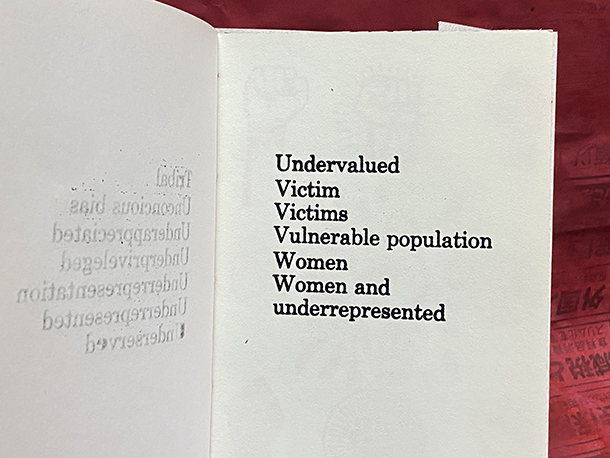
Meanwhile, Kucera’s Dictionary for Resistance project must find its place among a full, diverse agenda of the artist’s creative pursuits.
She told us, “As for showing regularly in galleries or maintaining a consistent studio practice — that’s never quite been me. At one time, I thought it would be. Now, though, I’m not sure if that model reflects how I want to use my energy. That said, my husband and I own 68 Prince Street Gallery in Kingston, New York [Instagram: @68princegallery]. There, we work with a curator to create a space where artists can gather and exhibit their work. Once again, I find myself creating with community in mind. I love building connections.”
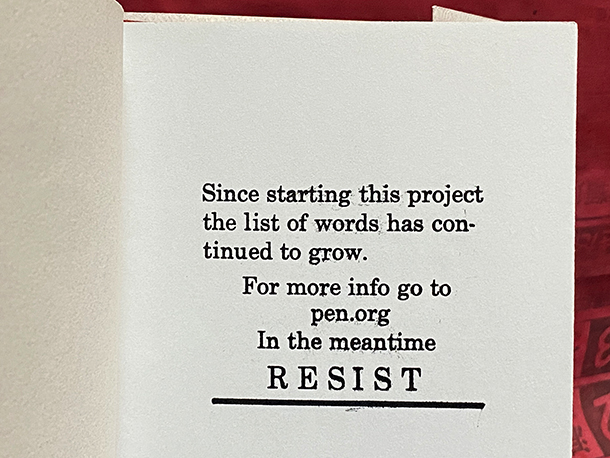
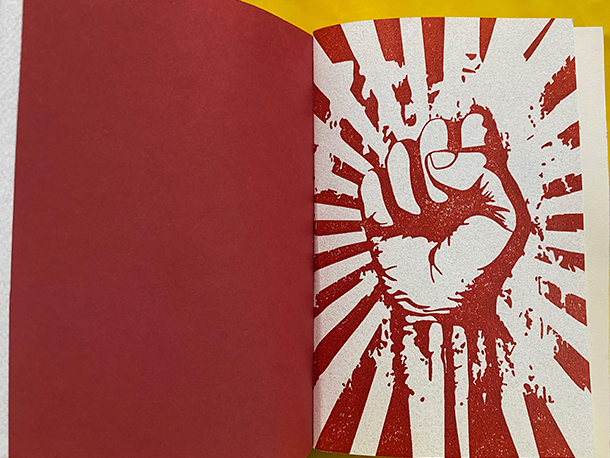
Below: The last page in the artist Paula Kucera’s new, limited-edition, hand-printed book, The Dictionary of Resistance.