ON THE ORIGIN OF “SPECIES”: PAUL PLUMADORE BRINGS IMAGINATION AND METICULOUS CRAFTSMANSHIP TO HIS NEW GROUP OF STRANGE COLLAGE IMAGES

A SELF-TAUGHT ARTIST AND FORMER DANCER PUSHES HIS DISTINCTIVE TECHNIQUE FORWARD IN A POWERFUL NEW SERIES


Published on February 19, 2026


by Edward M. Gómez


Not so fast, AI.

Nothing your know-it-all, steal-from-every-source, coldly programmed “brain” may come up with will ever rival the power of the human imagination, either when, as it did for William Wordsworth, it wanders “lonely as a cloud,” or when, for the rest of us, finding ourselves in extremis, problem-solving becomes a matter of life or death.

Humans can be pretty good at rising to the occasion and meeting big challenges, like sending men to the Moon or curing tuberculosis. They’ve been known for whipping up some dumb ideas too; we’re thinking of you, pet rocks, mullets, and mood rings.
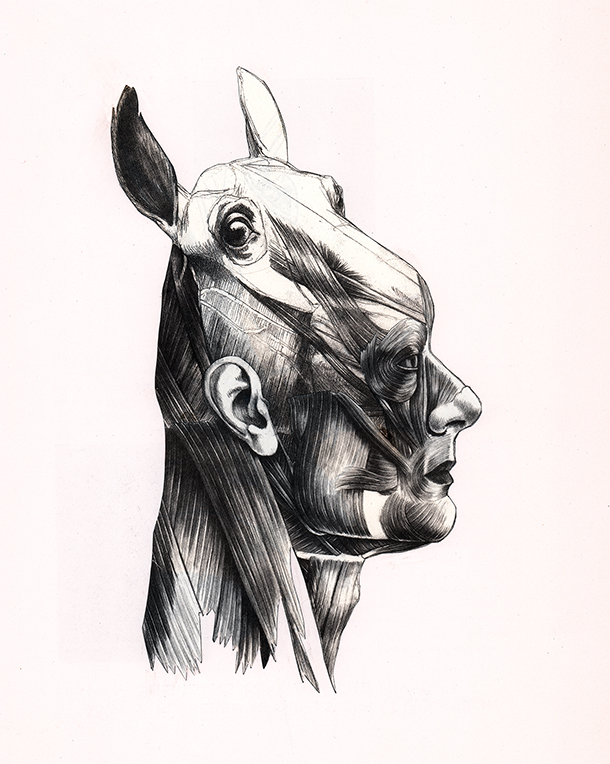
Paul Plumadore, “Species #22,” 2026, hand-cut printed matter, acid-free glue,
13 x 10.5 inches (33.02 x 26.67 centimeters). Photo by Paul Plumadore, courtesy of the artist

What we love about the collage artist Paul Plumadore’s work is that, like its creator, it’s all analog, all the time.

That’s a compliment, meaning that what we appreciate — and respect — are the purity, fecundity, originality, and unfailing power to surprise that are the hallmarks of his art.

What Plumadore creates reflects the richness of his imagination, to be sure. That he manages to give his ruminations such remarkable, tangible expression is a testament to the energy that animates his mind’s fertile reservoir of ideas — and impressive evidence of just how much a guy can do with a pair of scissors and a pot of glue.

The artist Paul Plumadore at work in his studio. Photo by Austin Johnson, courtesy of Paul Plumadore

A former dancer and choreographer who found his legs at the age of seven, Plumadore went on to earn an undergraduate degree from New York University’s Tisch School of the Arts in New York City, where he later joined the faculty of its dance department. He helped establish the NYU Dance Ensemble, directed the dance department at Sweet Briar College in Virginia, and led his own modern-dance troupe, Paul Plumadore & Co.

In 1974, after leaving the well-known Paul Taylor Dance Company, he produced his first collage. As he developed his ideas and collage-making technique, his work appeared in magazines and on numerous book jackets and record-album covers. brutjournal first published an article about Plumadore’s unusual collage works in March 2024.

Why did Plumadore move from the dance theater to what’s known in artspeak as a pictorial space in which he is able to “choreograph” or “stage” the way the components of his image-forming compositions interact in what are, in effect, his multi-part collage works’ visual performances in two-dimensional settings?

Paul Plumadore, “Species #26,” 2026, hand-cut printed matter, acid-free glue,
13 x 10.5 inches (33.02 x 26.67 centimeters). Photo by Paul Plumadore, courtesy of the artist

In a recent interview, he told brutjournal, “It remains a mystery to me. One could say I came upon doing collage work as an ‘outsider,’ and that it happened all in one moment. Other than 20 years’ extensive training in the dance and theater arts, I had had no training in any of the static arts.”

The artist further recalled, “One evening, I was revisiting a book from my childhood, The Wonders of Life on Earth, which contained both photographs and vibrant illustrations. At the time, there happened to be an X-ACTO knife on my desk, and on an impulse — which is where this story’s mystery lies — I began cutting its pages. Books had always seemed sacred to me, so at first, I felt as though I was committing a sacrilege, which added to the thrill. Upon seeing the results, an excitement shook me, and I knew I had stumbled upon a new life path. In short order, I found myself obsessively making this kind of art.”

Paul Plumadore, “Species #11,” 2025, hand-cut printed matter, acid-free glue,
13 x 10.5 inches (33.02 x 26.67 centimeters). Photo by Paul Plumadore, courtesy of the artist

Now, his newest creations, a group of collages in a series called “Species,” are on view (through February 28) in a three-artist exhibition at ArtWRKD, a gallery and agency representing artists located in Newtown, Pennsylvania. (Newtown lies to the northeast of Philadelphia and immediately to the west of Trenton, New Jersey.) The exhibition, “Torn.Cut.Scraped.,” also features works by Berly Ort and Kev Von Holt.

In Plumadore’s “Species” images, viewers who are familiar with his work will recognize the artist’s use, as his source material, of black-and-white printed matter from vintage books and magazines. In general, he makes a point of not using any such material that was published after 1930, so the printed matter he does select tends to have been produced by means of engraving, letter press, or gravure printing processes. This gives his collages a distinctly, sometimes deceptively historical look and air.

Paul Plumadore, “Species #25,” 2026, hand-cut printed matter, acid-free glue,
13 x 10.5 inches (33.02 x 26.67 centimeters). Photo by Paul Plumadore, courtesy of the artist

His “Species” compositions feel a bit sparer than some of their earlier, more densely packed counterparts. In these new works, Plumadore centers his images — they’re all heads — of peculiar, imaginary creatures against faint, mauve-colored backgrounds, a setting in which each one exudes a sculptural quality thanks to the clarity of their lines and the skill with which the artist has conjured up their volumes.

About the “Species” images’ support surfaces, Plumadore noted, “They’re mounted on late 19th-century paper — blank pages I salvaged from a set of large illustrated books. Time has altered those originally white pages, turning them a sort of reddish parchment color that I find appealing, although it’s rather tricky to color-balance in a photograph.”

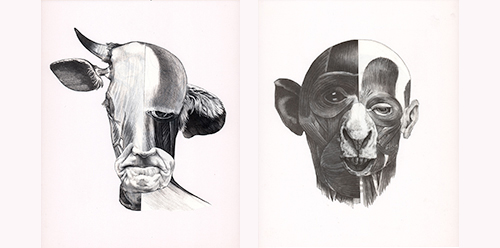
The eeriness of Plumadore’s “Species” critters, which combine both recognizable human and animal features, is their allure. (They were made from anatomical illustrations that were executed in pencil and then reproduced in print.) In one of the new collages, for example, a mostly bovine head is marked by a man’s fleshy, chin and curled lips. In another, a human eye and ear emerge from a horned animal’s skull.

Paul Plumadore, “Species #2,” 2025, hand-cut printed matter, acid-free glue,
13 x 10.5 inches (33.02 x 26.67 centimeters). Photo by Paul Plumadore, courtesy of the artist

What provoked his devising of these bizarre new images, which he began making last year using material that he had been gathering for some time?

Plumadore, who lives and works at his home in rural, northeastern Pennsylvania, explained, “Who can say where inspiration comes from? I’ve been working on and off since 2018 on a series called ‘Anatomy Lessons,’ in which, to date, there are now 80 works. They’ve all been inspired by the human form. I began making them when my framer gifted me a beautiful, illustrated, mid-19th-century treatise on human anatomy. That book was so rare and special, it took me months before I dared to cut it. It wasn’t until I added various animal forms into the mix that I realized I was moving into new territory, which became my ‘Species’ series.”

Plumadore also noted that he developed and worked on the first ten works in the new series at the same time. As they evolved, he said, he enjoyed “finding pieces of the various puzzles that were forming and moving from image to image until they coalesced.” He added, “It was great fun. They seemed to spark a nerve, so I began another group, and so on.”

Paul Plumadore, “Species #3,” 2025, hand-cut printed matter, acid-free glue,
13 x 10.5 inches (33.02 x 26.67 centimeters). Photo by Paul Plumadore, courtesy of the artist

Very visibly, these spookily intriguing pictures allude to both animals and humans, and, therefore, to nature and the life force, even if the whatever the unexpected creatures they depict might have to say seems impossible to know. Might some viewers find in these strange images some kind of message related to humanity’s relationship with nature or perhaps with the fate of the Earth in the face of humankind’s harmful, destructive actions against the well-being of the natural environment?

Pulmadore observed, “Nothing would make me happier than to make art that could influence political or environmental issues, but, alas, that isn’t how my brain processes information. Everything I experience becomes part of who I am, but none of that turns up on the surface [of my art]. My interests seem to lie in the universal, fantastical, and esoteric. I enjoy making images that make one’s eyes open.”

He added, “I’m steered by subconscious tides. I’ve tried to explain this state many times but still find that I’m rather stumped. It’s the reason I had to abandon a career as a commercial illustrator; when I was constrained by a dictated task with a concrete end goal, I felt that my work became stilted, without the air of mystery that I seek.”

Paul Plumadore, “Species #15,” 2025, hand-cut printed matter, acid-free glue,
13 x 10.5 inches (33.02 x 26.67 centimeters). Photo by Paul Plumadore, courtesy of the artist

Plumadore’s work finds historical affinities in, for example, the innovative collage work of the German, surrealist artist Max Ernst (1891-1976), especially as it was epitomized in his pioneering graphic novel and artist’s book Une semaine de bonté (A Week of Kindness), which was first published in 1934, in serialized form, in five consecutive volumes. To create the 182 collage compositions that appeared in that book, Ernst used images culled from Victorian novels, encyclopedias, and other old publications. Its main organizing theme was the seven days of the week, each of which was associated with a subtheme, including, among others, mud, water, blood, and the unknown.

Thinking about the character of his own work, Plumadore said, “I enjoy mixing diverse elements in ways that fool the brain into thinking they naturally exist together, as well as the challenge of cutting and gluing in ways that create something seamless. To make the finest cuts, I even use scalpels. The fact that all the material in this series incorporates pencil drawings makes these ‘Species’ pieces especially suitable to this quest of blending the unblendable.”

Paul Plumadore, “Species #7,” 2025, hand-cut printed matter, acid-free glue,
13 x 10.5 inches (33.02 x 26.67 centimeters). Photo by Paul Plumadore, courtesy of the artist

Like so many of the richly atmospheric, hard-to-classify collage works he has produced in the past, Plumadore’s “Species” images are enigmatic, elegant, and enchanting.

Reluctant to take a stab at deciphering the secrets his odd collage confections might hold, the artist told us, “My work seems to convey different things to different people. I make what pleases me visually while it’s on my worktable. The rest is between the finished works and their viewers — and I prefer to keep my personal opinions out of such encounters. Art needs its mystery.”

Paul Plumadore, “Species #6,” 2025, hand-cut printed matter, acid-free glue,
13 x 10.5 inches (33.02 x 26.67 centimeters). Photo by Paul Plumadore, courtesy of the artist