
TOKYO-TO SHIBUYAKOEN-DORI GALLERY’S LATEST SURVEY OF CONTEMPORARY JAPANESE ART BRUT IS FULL OF CLEVER, DELIGHTFUL SURPRISES
Published on December 1, 2025
by Edward M. Gómez
TOKYO — Traditionally, before the era of computer-generated images, 3D-printed objects, and the remarkable confections artificial intelligence has been whipping up in just about every category of the design and visual arts, the very magic of art-making lay in the often unbelievable, improbable, deeply original ways in which artists transformed their materials to create expressive, meaningful works of art.
At the heart of such activity lay the hands-on engagement of artists with the stuff — paper, paint on canvas, ink on paper, carved stone, or countless other materials — from which their works were made and the sparks in their imaginations that prompted their desire to create. Almost always, a key hallmark of the works such artists produced was some kind of visible or otherwise perceptible touch of the artist’s hand.
A deep appreciation of such craftsmanship employed in the service of a variety of distinctive creative visions is a current that runs through the exhibition “Encounter With the Known: Welcome to the World of Autobiographical Bricolage!”, which is now on view, through December 21, 2025, at Tokyo-to Shibuyakoen-dori Gallery. Located in the heart of Tokyo’s popular Shibuya district, it is an annex of the Museum of Contemporary Art Tokyo.
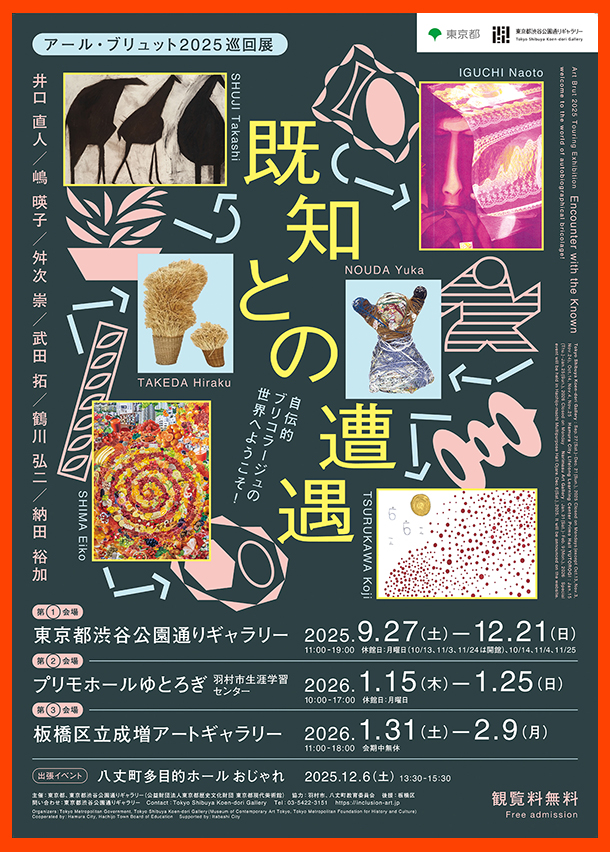
(Click here to open and view, in .pdf form, the gallery’s bilingual, Japanese-and-English pamphlet describing the exhibition.)
Since it opened in early 2020, shortly before the worldwide coronavirus pandemic was declared, this free-of-charge art space has become one of the most important venues in all of Japan for the presentation of paintings, drawings, mixed-media objects, and other creations produced by self-taught artists.
Each year, it presents several exhibitions, each of which is accompanied by a well-illustrated, bilingual (Japanese and English) catalogue. “Encounter With the Known” is its annual traveling exhibition; after its presentation in Shibuya, it will go on view at two other venues in the broader Tokyo metropolitan region.
Curated by Koya Kawahara, a young member of Tokyo-to Shibuyakoen-dori Gallery’s curatorial and administrative staff, the exhibition features works in various genres, made with a variety of materials, by six Japanese self-taught artists: Naoto Iguchi, Yuka Nouda, Eiko Shima, Takashi Shuji, Hiraku Takeda, and Koji Tsurukawa.
Kawahara told brutjournal that, when he began developing the exhibition’s central themes, he recalled the American director Steven Spielberg’s film Close Encounters of the Third Kind (1977), which became a worldwide hit. In that movie, Kawahara noted, human beings on Earth become obsessed but also charmed by an unexpected visitor from outer space. Their fear of a dramatically different, hitherto unknown kind of being is tempered as they get to know the alien.
Kawahara related the idea of the unknown to the French modern artist Jean Dubuffet’s appreciation of the unusual, unfamiliar forms of artistic expression for which, in the 1940s, he invented a new label, “art brut,” a French term meaning “raw art.” Dubuffet used the new label to refer to hard-to-classify works of art made by self-taught artists whose life circumstances found them living and producing their strange creations on the margins of mainstream society and culture.
With this exhibition, Kawahara explained, he wanted to flip a preoccupation with the unfamiliar and the unknown and, instead, focus more on the known — in this case, on familiar, everyday materials that, surprisingly, several Japanese artists have been using to make their works.
This led to his interest in the French term “bricolage,” which comes from the verb “bricoler,” meaning to whip something up or to throw something together. Insofar as all of the artists whose work are featured in “Encounter With the Known” have, in their own ways, created bricolage artworks using everyday, found, or repurposed materials, running through them Kawahara recognized a creative thematic through line.
Kawahara explained, “To make the word ‘bricolage’ easily understandable, in choosing the artworks, I focused on those that are three-dimensional or in which various kinds of materials are brought together, works that feature everyday motifs and materials. By selecting works that involve well-known, everyday motifs and materials, I wanted to show how the gap between what is already known and what is still unknown may be reinforced.”
That is to say, viewers of some of the most unusual works in the exhibition are sure to notice a big gap — or conceptual difference — between the familiar functions and meanings of certain materials the participating artists use to produce their images or objects and the new functions and meanings of those same materials, which emerge from the ways in which these art-makers so imaginatively handle them.
Technically speaking, the approaches to handling their materials the exhibition’s participating artists present are uncomplicated, but in each case, they transform the character of their materials with simple, surprising gestures and wit.
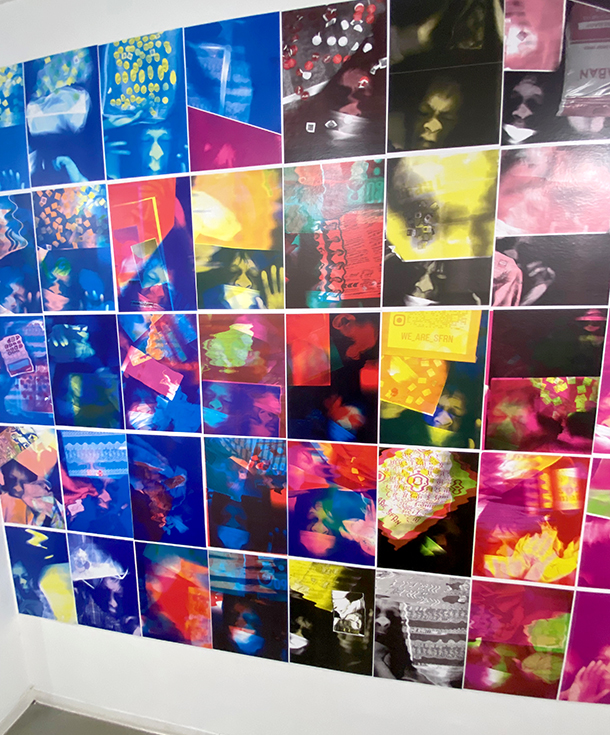
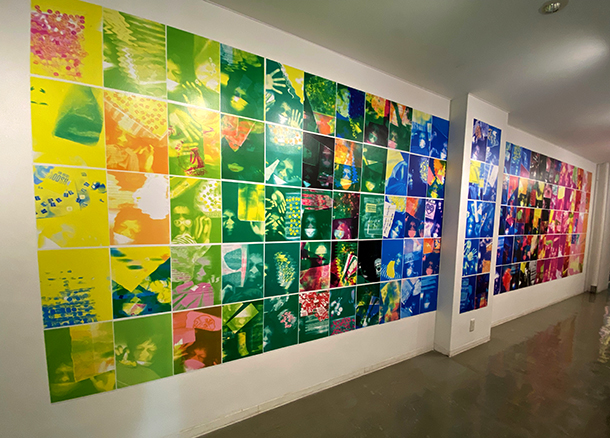
Naoto Iguchi (born 1971) makes self-portraits by placing his face on the glass surface of a color photocopier machine. Sometimes he also places objects that he likes on the glass, next to his face. By moving his body while copies of his face are being made, Iguchi creates interesting distortions in the portraits that result from this unusual process. They’re colorful, energetic, psychedelic, and wildly expressive. In the current show, a broad section of one wall in the long corridor leading into the main exhibition spaces is covered with a boldly colored grid of Iguchi’s photocopy images.
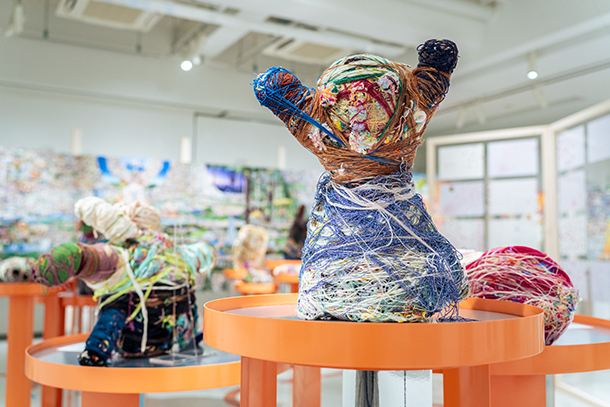
Yuka Nouda (born 1966), calls the mixed-media, abstract sculptural objects she creates “Noudama.” This original portmanteau is made up of the artist’s surname, “Nouda” (納田), and the word “tama” (玉), which means “ball” or “sphere.” Nouda wraps assorted found objects in discarded thread and scraps of fabric, creating mysterious forms that sometimes resemble human figures and often exude some kind of restless energy. They bring to mind cocoons or long-preserved, ancient vessels unearthed from archaeological sites.
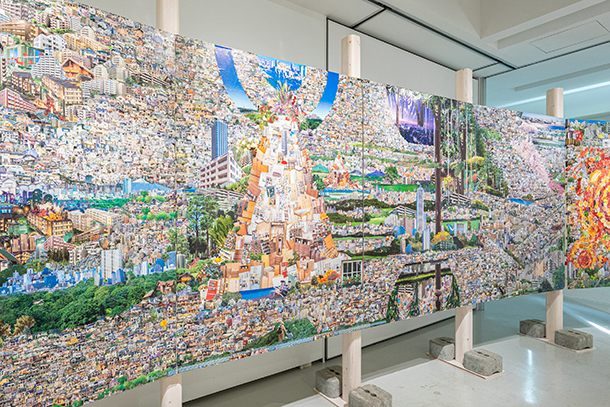
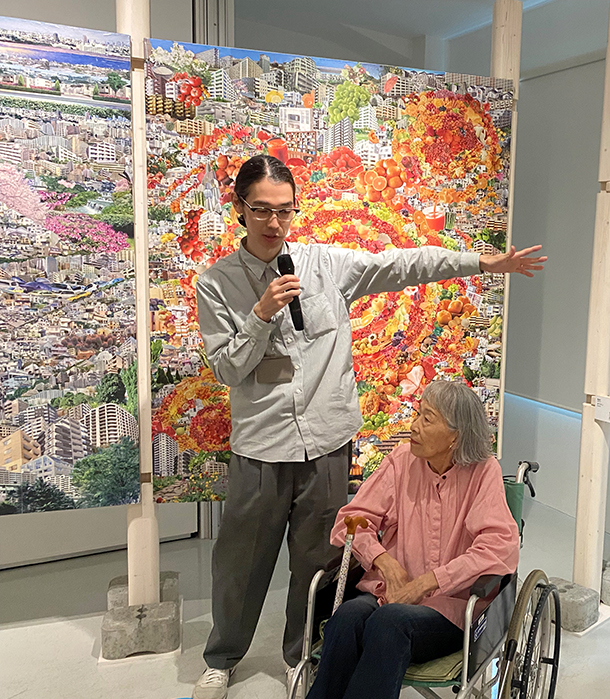
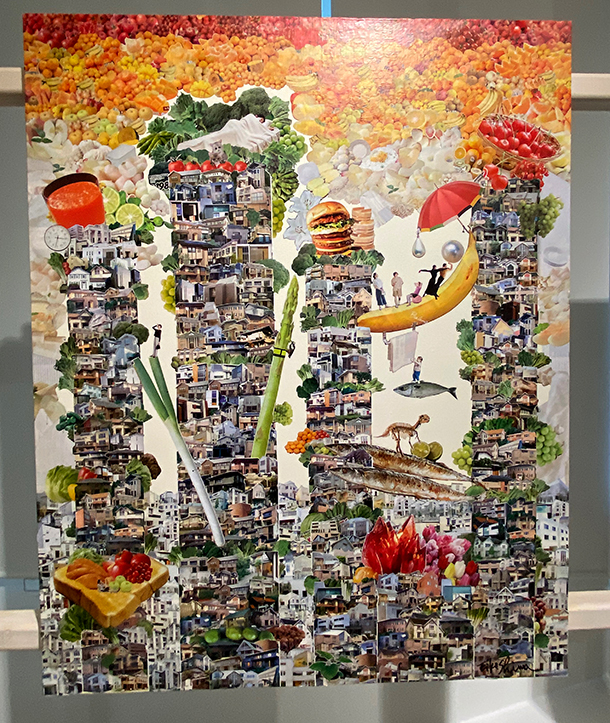
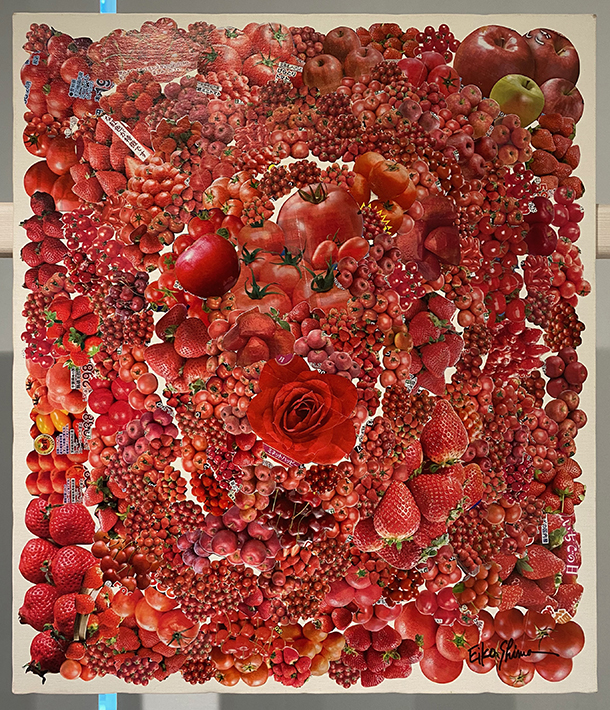
Eiko Shima (born 1943) is an older, Tokyo-based artist who uses images clipped from advertising flyers (including many forms of junk mail), magazines, promotional brochures, and other printed matter, assembling them into sprawling, wonderfully stylized collage compositions. Her works tend to address particular themes, from aspects of nature to various kinds of architectural forms (apartment buildings, skyscrapers, or individual houses).
In one of Shima’s large works, “La Vie en Rose” (2023), a cornucopia of roses, tomatoes, and strawberries form a gigantic, red spiral of nature’s bounty. In another one of the artist’s mega-collages, clusters of modern buildings seem to ooze out from the edges of another spiral form, this one resembling the produce section of a large supermarket gone wild.
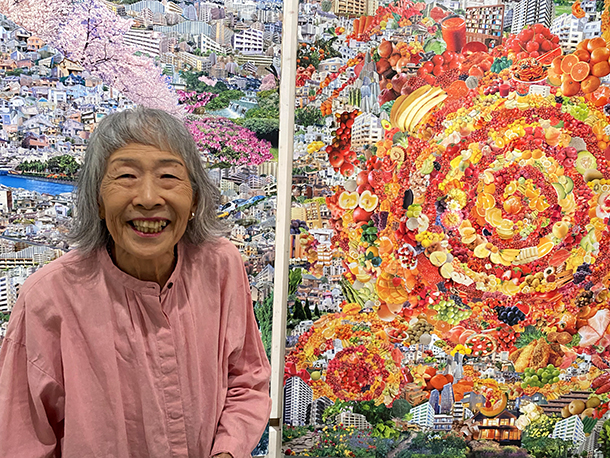
At the opening of the exhibition, Shima showed visitors the little boxes in which she stores the neatly separated-by-category images of flowers, fruits, buildings, and other subjects she routinely cuts out of her source materials. She said, “I don’t have a separate studio. I just work on a little table in my living room.”
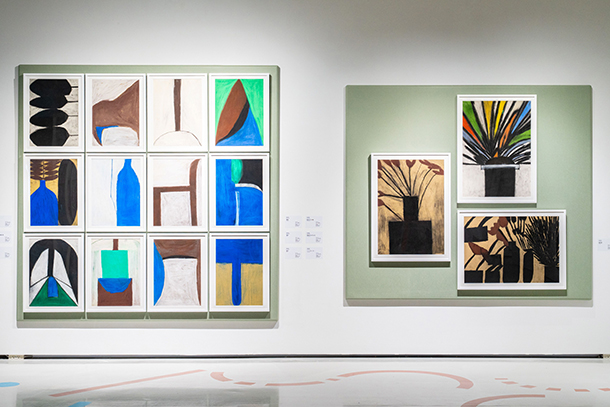
Takashi Shuji (1974-2021) was a self-taught artist who was based in Nishinomiya, a town situated about halfway between Kobe and Osaka, two large port cities in the Kansai region of western Japan. In Nishinomiya, Shuji, who had Down syndrome, took part in the activities of the Suzukake Art Club, a division of a local institution for disabled people.
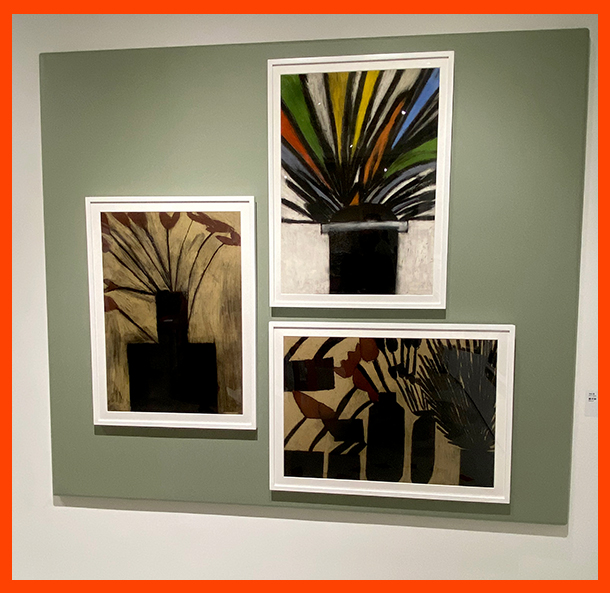
There, he developed a unique style of drawing, using pastel chalks on paper, in a way that abstracted his familiar, everyday subjects, including birds, plants, bottles, and bicycles. Shuji depicted them in deep-black or vibrantly colored silhouettes set against plain backgrounds. Marked by a strong sense of design and powerful compositions, the character of Shuji’s pictures is unmistakably, unwittingly modern.
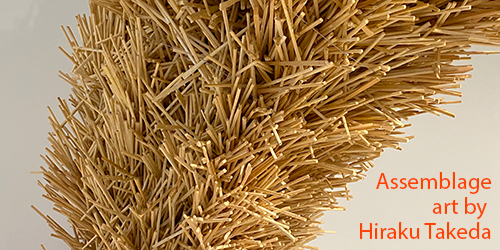
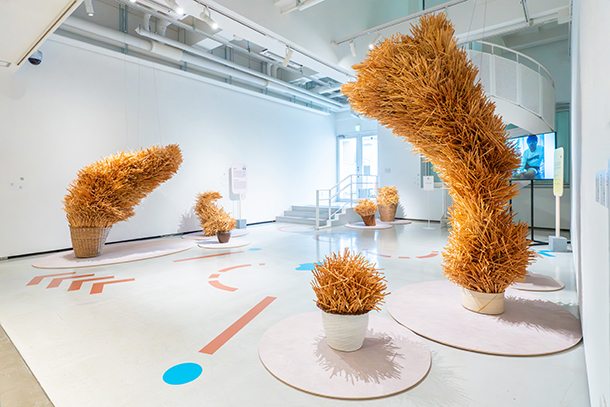
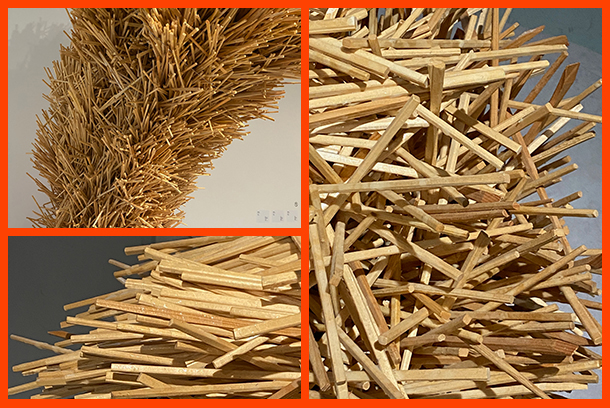
Some of the most striking objects on view in “Encounter With the Known” are the strange, bushy or towering assemblages made by Hiraku Takeda (born 1988), an artist who uses disposable chopsticks — many hundreds or thousands of these wooden sticks per sculpture — to make his richly textured creations. From a short distance, they resemble pots or baskets filled with long, crispy French fries, but when seen up close, they reveal their unexpected nature, and Takeda’s clever transformation of his nondescript material cannot be missed.
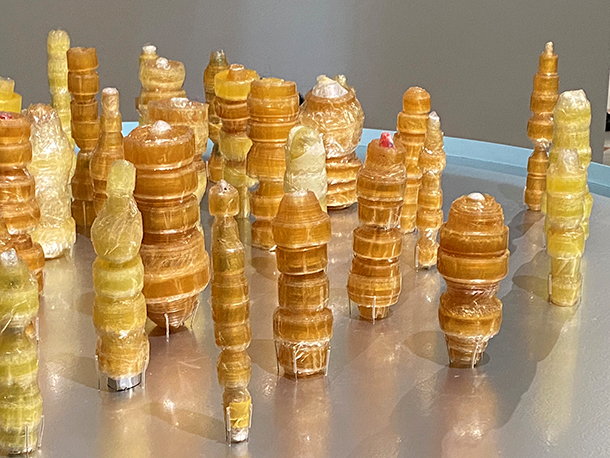
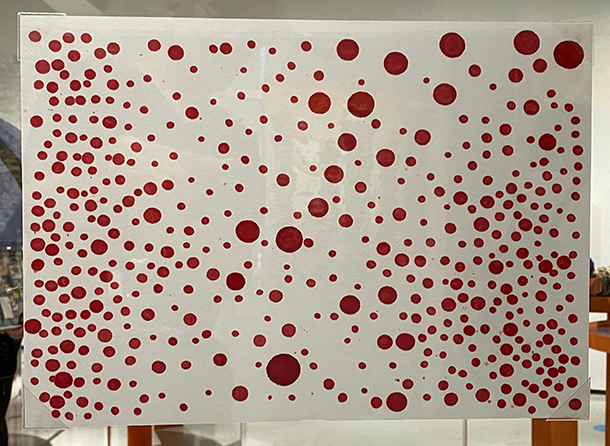
Koji Tsurukawa (born 1973), employs the simplest of shapes — circular, red dots made by pressing oil-based ink pens against paper — to create rhythmic, abstract compositions resembling dense constellations of deep-scarlet blood stains. Tsurukawa also places numbers, letters, and words, whose written forms he manipulates, within his compositions, adding to their overall sense of visual texture and also to their mystery. For all their simplicity and minimalist air, Tsurukawa’s images convey a sense of this artist’s intuitive understanding of the expressive power of abstraction. Tsurukawa also makes abstract, mini-tower sculptures using rolls of cellophane tape.
About the works in the exhibition and the profile of self-taught artists in Japan to whose creations the “art brut” label has been applied, Kawahara told brutjournal that “even as they demonstrate their own individual ways of thinking (their artworks and they themselves, as artists, are autonomous), their creative processes and their association with a collective community [of like-minded art-makers] are particular characteristics” that stand out when their various productions and the circumstances in which they develop and emerge are examined.
The curator noted that, while each artist’s life and activities may be associated with a nearby society in which each artist lives and works, “wherever they are, they also [exist in] an isolated world.” That’s because their creative activities, their sensibilities, their personal outlooks, and the ways in which they center their art-making in their lives sets them apart from most other people.
In Japan, as appreciation for the creations of self-taught artists continues to grow and evolve, Kawahara noted that, going forward, “how their individuality can be protected and what possibilities there will be for them to express themselves — these could be important concerns when thinking about Japanese art brut.”
Fortunately, in the hands of Tokyo-to Shibuyakoen-dori Gallery’s well-informed, capable curatorial team, Japanese art brut creators may be assured that their artistic productions, no matter how strange or unexpected they might appear, will be presented with admiration, style, and an abiding sense of appreciation for their singular creative visions.

The installation design of “Encounter With the Known: Welcome to the World of Autobiographical Bricolage!” was created by Tamari Architects, a company based in Nakatsu, Osaka. The exhibition’s graphic-design scheme, which includes simple graphic elements on walls and floors to help guide visitors, was produced by Homesickdesign, a company based in Morioka, in Iwate Prefecture. It has developed projects in the fields of art, education, and place-making with a goal of helping to support regional industry and culture.
After its showing at Tokyo-to Shibuyakoen-dori Gallery, “Encounter With the Known: Welcome to the World of Autobiographical Bricolage!” will be presented at two other venues within the broader Tokyo metropolitan area. Here is the exhibition’s schedule:
Tokyo-to Shibuyakoen-dori Gallery
Shibuya Workers’ Welfare Hall, 1st floor
1-19-8 Jinnan, Shibuya-ku, Tokyo 150-0041
(located diagonally across the street from Shibuya PARCO, a large department store)
On view through December 21, 2025
Second venue:
Hamura City Lifelong Learning Center
Primo Hall YUTOROGI
1-11-5 Midorigaoka, Hamura, Tokyo 205-0003
On view from January 15 through January 25, 2026
Third venue:
Itabashi-ku Narimasu Art Gallery
Ariesu Building, 3rd floor
Narimasu Library Annex 3-13-1 Narimasu, Itabashi-ku,
Tokyo 175-0094
On view from January 31 through February 9, 2026